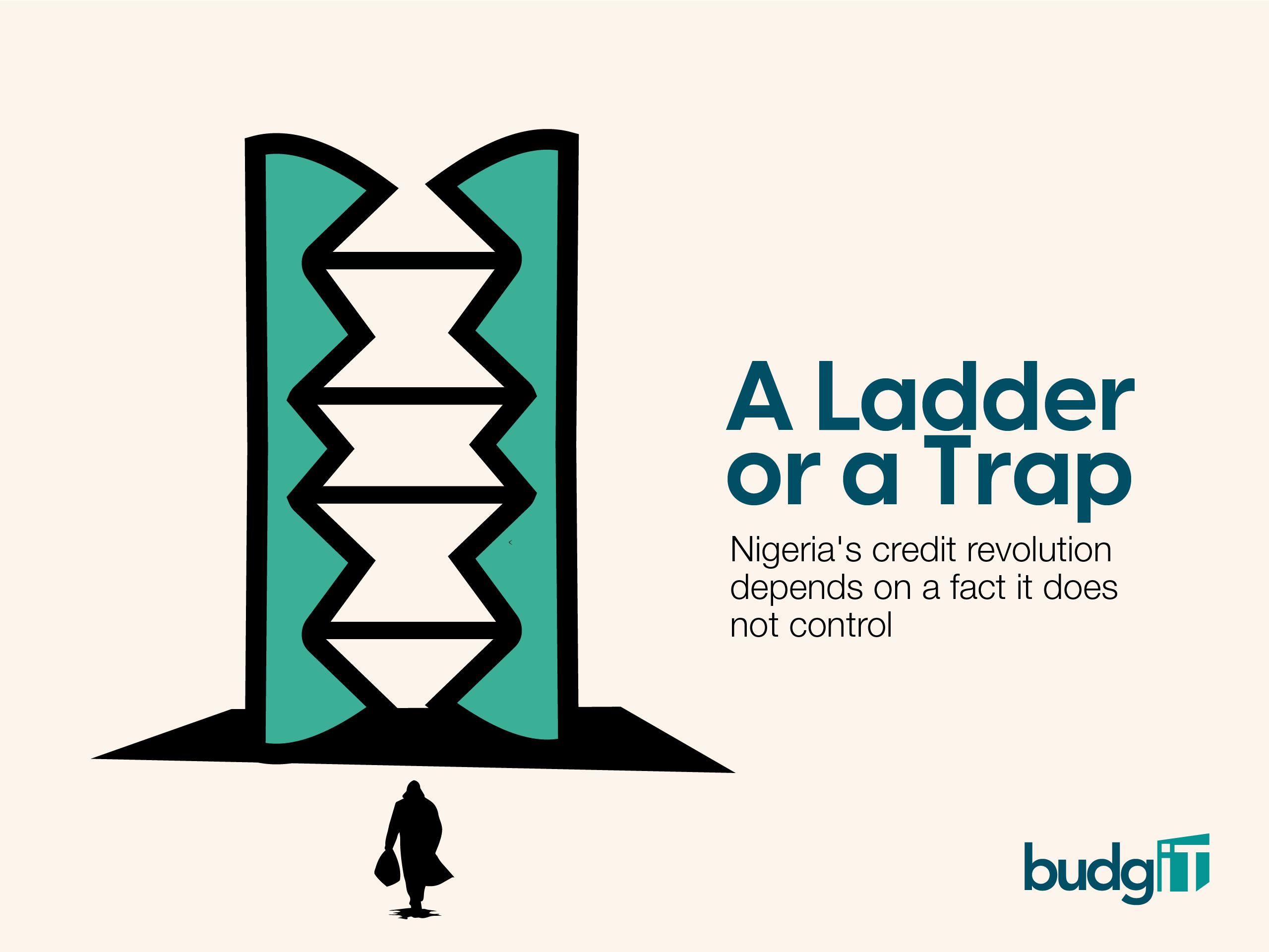

A Ladder or a Trap: Nigeria’s credit revolution depends on a fact it does not control

Author

Victor Ejechi

Somewhere in Lagos this morning, a civil servant on the new minimum wage worked out that her salary runs out around the twentieth of the month.  By the twenty-first, she has borrowed against next month’s pay through one of the instant-loan apps millions of Nigerians now have on their phones, money that arrives in minutes, at interest no one dares annualise, repayable in days, and enforced by the threat of the app texting her debt to everyone in her contacts list. 

Lately, she has heard there is another way to borrow, something the government set up, at a fraction of the cost, and without the threat of being shamed for needing it.

She is right that the apps are a trap, and right that something cheaper and less humiliating would be a relief. But there is a harder question underneath hers, and the setup has already answered it. A woman whose salary runs out on the twentieth is not borrowing to buy a sewing machine. She is borrowing to buy garri until payday. That is the distinction that should keep policymakers awake. There is credit that builds something, and there is credit that only makes a short month survivable, and most of the commentary around CREDICORP has skipped past which one this is.

Let me be fair to the idea first, because it deserves fairness. The Nigerian Consumer Credit Corporation, set up by the federal government in April 2024, is one of the most interesting pieces of economic plumbing this administration has attempted. It does not hand out loans itself, which is the part most people miss. 

It sits behind the banks, the fintechs, the microfinance institutions and the cooperatives as a wholesale financier and guarantor, lowering their risk so they will lend to Nigerians they would otherwise have ignored. Its stated ambition is to reach half of the country’s working population, estimated at 122 million people, including everyone aged 15 and older, with access to consumer credit by 2030, and to make sure every economically active citizen has a real credit score. By the corporation’s own account, it had channelled over 30 billion naira to more than 200,000 Nigerians by the end of 2025.

The problem it was built to solve is real and almost violent in its consequences. For most of our history, the informal economy kept families alive through ajo, esusu and adashe, but it left the people inside it as financial ghosts. 

A market woman could keep a daily contribution for fifteen years without missing a day, but to a formal bank, she still did not exist. No data, no score, no history, no loan. Into that vacuum poured the digital loan sharks, lending small sums at annualised rates that ran past six hundred per cent and collecting through harassment, fake debt alerts and the public humiliation of borrowers and their families. 

A national credit infrastructure is the correct answer to that world. A credit score, done properly, is a passport: it lets a diligent borrower carry her reputation with her, so that paying rent on time becomes an asset rather than a private virtue nobody can see. There is nothing free-market or pro-poor about leaving people at the mercy of unlicensed lenders. 

CREDICORP, in principle, is the state doing something it is actually well suited to do, which is build the rails and then get out of the way. So this is not a piece against credit. It is a piece against confusing the rails with the journey.

The Rails and the Journey

Credit is not wealth. Credit is a claim on your future income, brought forward to the present. Whether that is a blessing or a trap depends entirely on one thing: whether the money you borrow is used to create more income than it costs you to repay. Borrow to buy a tricycle, a freezer, a set of tools, or a solar panel that ends your generator bills, and the loan pays for itself and then some. That is credit as a ladder. Borrow to buy this week’s food and next month’s rent, and the loan creates no income at all. You have simply moved a shortfall from today into a tomorrow that arrives with interest attached. That is credit as a trap, and the line between the two runs straight through the kitchen.

Which brings us to the state of the kitchen. The official story in 2026 is one of relief, and there is something to it. Headline inflation, which was still running in the high twenties as recently as early 2025, had eased to just under 16 per cent by April 2026 on the National Bureau of Statistics’ rebased index. But even as the broad numbers improved, the price of the one thing the poor cannot postpone buying started rising faster than everything else again. 

In January, food inflation cooled to single digits for the first time in over a decade. Ministers took their bows. But anyone who actually buys food saw what happened next. By the bureau’s own figures, food inflation climbed from under nine per cent in January to roughly 16 per cent by April, and in that month it crossed back above the headline rate for the first time since the previous August. The relief is real, but it is fragile, and it has not reached the plate.

Now put the two facts side-by-side. A government is rolling out cheap, accessible consumer credit at the precise moment that food, the most basic and least deferrable expense, is climbing faster than wages can follow. You do not need a model to see the risk. In an economy where a large share of households cannot cover the month on what they earn, the most natural use of a new credit line is not the tricycle. It is the rent, the school fees, the food. People do not borrow to invest when they are borrowing to survive. They borrow to survive.

This is where a well-meaning scheme can quietly invert its own purpose. The credit score that was meant to be a passport becomes, for the woman in Lagos, a record of desperation. She takes a consumption loan because she is squeezed, then struggles to repay it because a loan spent on garri provides no means of repayment. The loan rolls over or defaults, and she watches the very score that was supposed to open doors swing shut against her. We will have built, with the best intentions, a national system that documents her poverty with great precision and then penalises her for it. As an invisible borrower, she at least had the dignity of being unseen. Scored and indebted, she is now visible, ranked, and locked out, which is a crueller place to be.

There is a macroeconomic edge to this too, and policy-minded readers will recognise it. Consumer credit poured into an economy with a weak domestic supply does not summon goods into existence; it adds demand on top of demand that the system cannot yet meet. When more naira chase the same constrained basket of food and housing, the predictable result is upward pressure on exactly the prices that are already hurting. A credit programme can, if it is not careful, end up partly financing the inflation it is meant to help people endure. That is the kind of feedback loop that looks like generosity in the launch communiqué and like a debt overhang three years later.

None of this is an argument to slow CREDICORP down. It is an argument about sequencing and design, which is where good intentions either become good outcomes or do not. Three things would make the difference.

First, bias the system, hard and deliberately, toward productive credit. The vehicles, the solar systems, the equipment, the working capital: the borrowing that builds an income to repay itself. The corporation’s early partnerships around locally assembled vehicles and home solar are exactly the right instinct, and the design should keep pulling in that direction rather than drifting toward the easier, higher-volume, more dangerous business of financing day-to-day consumption. Pure consumption lending should carry guardrails, not just incentives.

Second, consumer protection has to be as robust as the lending is ambitious. Honest interest disclosure, hard limits on what a struggling borrower can be loaded with, a real mechanism to keep a single missed survival loan from becoming a life sentence on someone’s score, and enforcement against the predatory practices the scheme is supposed to replace rather than merely compete with. A credit revolution without strong borrower protection is just a more organised version of the problem.

Third, and this is the part no credit corporation can do by itself, the only durable fix for survival borrowing is to make survival affordable. Credit cannot substitute for income, and it cannot manufacture purchasing power. As long as food outpaces wages, every credit line offered to a poor household is an invitation to borrow against a future that is getting more expensive. The work that actually protects the borrower happens upstream, in food production, in real wages, and in the cost of energy and transport, which is built into the price of everything. CREDICORP can lay magnificent rails. It cannot lay the track through a country where the train has nothing to carry.

Telling a squeezed household to borrow only for productive purposes and to repay on time is sound, but it is also a little like telling someone treading water to swim more efficiently. Literacy matters, but it is not a substitute for an income that reaches the end of the month.

So I come back to the woman whose salary runs out on the twentieth. The system we are building will, very soon, offer her money. That is genuine progress, and I would not want to be the person who tells her it should not exist. But whether that loan turns out to be the best thing that happened to her finances or the beginning of a quiet spiral depends on a fact that has nothing to do with CREDICORP’s design and everything to do with the economy it is operating in. It depends on whether, by the time the repayment falls due, she has been able to turn the money into something more than a meal.

Build the credit system. Build the scores. They are good and overdue. But let us be honest about what they are. They are a powerful tool, and a tool is only as good as the hand and the economy that wields it. A loan is not income. A score is not a salary. And a credit line, however cheap and dignified, is not a meal. Until the country underneath it can be fed, we should be very careful about how loudly we celebrate teaching the hungry to borrow.

Share This Post

Post Author: Victor Ejechi

Somewhere in Lagos this morning, a civil servant on the new minimum wage worked out that her salary runs out around the twentieth of the month.  By the twenty-first, she has borrowed against next month’s pay through one of the instant-loan apps millions of Nigerians now have on their phones, money that arrives in minutes, at interest no one dares annualise, repayable in days, and enforced by the threat of the app texting her debt to everyone in her contacts list. 

Lately, she has heard there is another way to borrow, something the government set up, at a fraction of the cost, and without the threat of being shamed for needing it.

She is right that the apps are a trap, and right that something cheaper and less humiliating would be a relief. But there is a harder question underneath hers, and the setup has already answered it. A woman whose salary runs out on the twentieth is not borrowing to buy a sewing machine. She is borrowing to buy garri until payday. That is the distinction that should keep policymakers awake. There is credit that builds something, and there is credit that only makes a short month survivable, and most of the commentary around CREDICORP has skipped past which one this is.

Let me be fair to the idea first, because it deserves fairness. The Nigerian Consumer Credit Corporation, set up by the federal government in April 2024, is one of the most interesting pieces of economic plumbing this administration has attempted. It does not hand out loans itself, which is the part most people miss. 

It sits behind the banks, the fintechs, the microfinance institutions and the cooperatives as a wholesale financier and guarantor, lowering their risk so they will lend to Nigerians they would otherwise have ignored. Its stated ambition is to reach half of the country’s working population, estimated at 122 million people, including everyone aged 15 and older, with access to consumer credit by 2030, and to make sure every economically active citizen has a real credit score. By the corporation’s own account, it had channelled over 30 billion naira to more than 200,000 Nigerians by the end of 2025.

The problem it was built to solve is real and almost violent in its consequences. For most of our history, the informal economy kept families alive through ajo, esusu and adashe, but it left the people inside it as financial ghosts. 

A market woman could keep a daily contribution for fifteen years without missing a day, but to a formal bank, she still did not exist. No data, no score, no history, no loan. Into that vacuum poured the digital loan sharks, lending small sums at annualised rates that ran past six hundred per cent and collecting through harassment, fake debt alerts and the public humiliation of borrowers and their families. 

A national credit infrastructure is the correct answer to that world. A credit score, done properly, is a passport: it lets a diligent borrower carry her reputation with her, so that paying rent on time becomes an asset rather than a private virtue nobody can see. There is nothing free-market or pro-poor about leaving people at the mercy of unlicensed lenders. 

CREDICORP, in principle, is the state doing something it is actually well suited to do, which is build the rails and then get out of the way. So this is not a piece against credit. It is a piece against confusing the rails with the journey.

The Rails and the Journey

Credit is not wealth. Credit is a claim on your future income, brought forward to the present. Whether that is a blessing or a trap depends entirely on one thing: whether the money you borrow is used to create more income than it costs you to repay. Borrow to buy a tricycle, a freezer, a set of tools, or a solar panel that ends your generator bills, and the loan pays for itself and then some. That is credit as a ladder. Borrow to buy this week’s food and next month’s rent, and the loan creates no income at all. You have simply moved a shortfall from today into a tomorrow that arrives with interest attached. That is credit as a trap, and the line between the two runs straight through the kitchen.

Which brings us to the state of the kitchen. The official story in 2026 is one of relief, and there is something to it. Headline inflation, which was still running in the high twenties as recently as early 2025, had eased to just under 16 per cent by April 2026 on the National Bureau of Statistics’ rebased index. But even as the broad numbers improved, the price of the one thing the poor cannot postpone buying started rising faster than everything else again. 

In January, food inflation cooled to single digits for the first time in over a decade. Ministers took their bows. But anyone who actually buys food saw what happened next. By the bureau’s own figures, food inflation climbed from under nine per cent in January to roughly 16 per cent by April, and in that month it crossed back above the headline rate for the first time since the previous August. The relief is real, but it is fragile, and it has not reached the plate.

Now put the two facts side-by-side. A government is rolling out cheap, accessible consumer credit at the precise moment that food, the most basic and least deferrable expense, is climbing faster than wages can follow. You do not need a model to see the risk. In an economy where a large share of households cannot cover the month on what they earn, the most natural use of a new credit line is not the tricycle. It is the rent, the school fees, the food. People do not borrow to invest when they are borrowing to survive. They borrow to survive.

This is where a well-meaning scheme can quietly invert its own purpose. The credit score that was meant to be a passport becomes, for the woman in Lagos, a record of desperation. She takes a consumption loan because she is squeezed, then struggles to repay it because a loan spent on garri provides no means of repayment. The loan rolls over or defaults, and she watches the very score that was supposed to open doors swing shut against her. We will have built, with the best intentions, a national system that documents her poverty with great precision and then penalises her for it. As an invisible borrower, she at least had the dignity of being unseen. Scored and indebted, she is now visible, ranked, and locked out, which is a crueller place to be.

There is a macroeconomic edge to this too, and policy-minded readers will recognise it. Consumer credit poured into an economy with a weak domestic supply does not summon goods into existence; it adds demand on top of demand that the system cannot yet meet. When more naira chase the same constrained basket of food and housing, the predictable result is upward pressure on exactly the prices that are already hurting. A credit programme can, if it is not careful, end up partly financing the inflation it is meant to help people endure. That is the kind of feedback loop that looks like generosity in the launch communiqué and like a debt overhang three years later.

None of this is an argument to slow CREDICORP down. It is an argument about sequencing and design, which is where good intentions either become good outcomes or do not. Three things would make the difference.

First, bias the system, hard and deliberately, toward productive credit. The vehicles, the solar systems, the equipment, the working capital: the borrowing that builds an income to repay itself. The corporation’s early partnerships around locally assembled vehicles and home solar are exactly the right instinct, and the design should keep pulling in that direction rather than drifting toward the easier, higher-volume, more dangerous business of financing day-to-day consumption. Pure consumption lending should carry guardrails, not just incentives.

Second, consumer protection has to be as robust as the lending is ambitious. Honest interest disclosure, hard limits on what a struggling borrower can be loaded with, a real mechanism to keep a single missed survival loan from becoming a life sentence on someone’s score, and enforcement against the predatory practices the scheme is supposed to replace rather than merely compete with. A credit revolution without strong borrower protection is just a more organised version of the problem.

Third, and this is the part no credit corporation can do by itself, the only durable fix for survival borrowing is to make survival affordable. Credit cannot substitute for income, and it cannot manufacture purchasing power. As long as food outpaces wages, every credit line offered to a poor household is an invitation to borrow against a future that is getting more expensive. The work that actually protects the borrower happens upstream, in food production, in real wages, and in the cost of energy and transport, which is built into the price of everything. CREDICORP can lay magnificent rails. It cannot lay the track through a country where the train has nothing to carry.

Telling a squeezed household to borrow only for productive purposes and to repay on time is sound, but it is also a little like telling someone treading water to swim more efficiently. Literacy matters, but it is not a substitute for an income that reaches the end of the month.

So I come back to the woman whose salary runs out on the twentieth. The system we are building will, very soon, offer her money. That is genuine progress, and I would not want to be the person who tells her it should not exist. But whether that loan turns out to be the best thing that happened to her finances or the beginning of a quiet spiral depends on a fact that has nothing to do with CREDICORP’s design and everything to do with the economy it is operating in. It depends on whether, by the time the repayment falls due, she has been able to turn the money into something more than a meal.

Build the credit system. Build the scores. They are good and overdue. But let us be honest about what they are. They are a powerful tool, and a tool is only as good as the hand and the economy that wields it. A loan is not income. A score is not a salary. And a credit line, however cheap and dignified, is not a meal. Until the country underneath it can be fed, we should be very careful about how loudly we celebrate teaching the hungry to borrow.
Share This Post

Read More

Headlines

Private Sector Economic Intelligence

Better business decisions start with the right insights. At BudgIT Foundation, we are developing a structured Economic Intelligence Product designed specifically for private…