
Every year, Nigerian state governments approve billions of naira for healthcare, including hospitals, primary healthcare centres, medicines, equipment and health workers. But approval is only the beginning. The real test is whether allocations translate into accessible, better-quality services.
State health budget and expenditure figures for 2024 and 2025 reveal a mixed picture. Some states improved their spending performance, while others recorded substantial declines. These differences raise questions about budget implementation and how effectively states turn financial commitments into healthcare delivery.
The World Health Organization’s report, Public Financing for Health in Africa: From Abuja to the SDGs, highlights that adequate financing must be matched by effective spending. Allocations cannot guarantee better services if governments struggle to implement plans or direct resources to priority areas.
The state-level figures illustrate this challenge. In Abia State, health budget performance declined from 50.5% in 2024 to 35.1% in 2025, even though the approved health budget increased from approximately N70.47 billion to N74.11 billion. Adamawa recorded a similar pattern, with performance falling from 65.3% to 41.3% despite a substantial increase in its approved allocation.
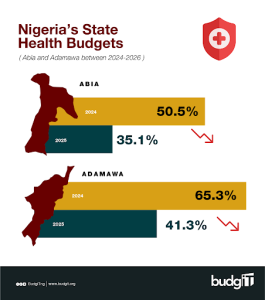
The figures do not explain why performance declined. Possible causes include revenue constraints, delayed releases, procurement challenges or implementation difficulties. They show, however, that a larger budget does not automatically mean a greater proportion will be spent. World Bank and WHO work on health budget execution similarly show that weaknesses in the budget process can prevent planned expenditure from becoming services. States must examine the full cycle, from planning and approval to releases, procurement, payment and implementation.
The figures also show that improvement is possible. Bayelsa’s health budget performance rose from 78.1% in 2024 to 91.4% in 2025. Benue improved from 74.6% to 92%, while Ondo increased from 58.1% to 82.6%. These results indicate that a greater proportion of budgets was spent, offering a starting point for examining planning and implementation.
However, high execution rates should not automatically be interpreted as evidence of better healthcare outcomes. Expenditure figures tell us how much of a budget was spent, but not necessarily whether the spending was well targeted or improved the availability, affordability and quality of services.
BudgIT’s Strengthening Health Systems: Health Financing Report reinforces the importance of connecting health financing with measurable results. Spending performance should therefore be assessed alongside indicators such as essential medicine availability, staffing levels, functioning equipment and access to services at primary healthcare centres. The objective is not simply to spend more, but to address priority needs and deliver tangible benefits.
Comparisons also depend on consistent data. A state’s execution rate is meaningful only when expenditure is measured against the appropriate budget version and the same reporting period. Using revised budgets matters because approved allocations may change during the year. It provides a more relevant basis for assessing performance than comparing spending against an outdated original allocation. Even then, differences in accounting classifications and reporting practices can affect comparisons across states.
Katsina recorded health expenditure equivalent to 145.8% of its revised 2025 health budget, while Yobe recorded 159%. Because the analysis uses revised budgets, these figures require careful interpretation. Although expenditure exceeded the revised budget in both states, the figures alone do not explain why. The important question is what drove the higher expenditure and whether it reflected the states’ health priorities and translated into better service delivery.
The African Health Observatory Platform’s Nigeria profile highlights the burden of healthcare costs on households, including reliance on out-of-pocket payments. When facilities lack medicines, trained personnel or functioning equipment, patients may pay privately, travel farther or delay care. Effective budget implementation cannot solve every health-system weakness, but it can help address these gaps.
Primary healthcare deserves particular attention because it is often the first point of contact between citizens and the health system. Nigeria’s Basic Health Care Provision Fund provides a framework for financing essential primary healthcare services. Funding mechanisms also require effective implementation, capable facilities and monitoring to ensure resources reach beneficiaries.
States should improve coordination between health and finance ministries, procurement and payment processes, and align spending with facility and community needs. Reporting should connect expenditure to service indicators so citizens can see what public spending achieves. The figures help compare execution and identify changes, but should be assessed alongside facility conditions, service coverage and health outcomes.
State governments already publish budget implementation reports and supplementary budget documents. The priority is to use these records to assess spending performance and connect expenditure to outcomes. BudgIT, through its State Fiscal Transparency League initiative, assesses how states perform on fiscal transparency and the public availability of budget information. This kind of scrutiny helps citizens, journalists and civil society organisations identify gaps, ask better questions and press governments to explain spending decisions. The objective is not simply to publish financial data, but to make it useful for public accountability.
Ultimately, state health budgets should be judged by more than the amounts allocated or spent. Budget execution is an important measure of public financial management, but its significance lies in what it enables governments to deliver.
The real test of a health budget is whether citizens can access reliable, affordable and quality healthcare when they need it. Moving from budgetary promises to healthcare delivery requires adequate resources, effective implementation and evidence of results. BudgIT’s work on fiscal transparency and public accountability helps strengthen this process by making public finance information more accessible and enabling citizens to scrutinise how governments manage public resources. Ultimately, the value of a health budget lies not in the amount approved or spent, but in the difference it makes to people’s lives.