
As Nigeria navigates the fiscal complexities of 2026, the country faces a structural dilemma that goes beyond ordinary budget trade-offs. Each year, Nigeria is pulled between two competing imperatives: meeting immediate debt-servicing obligations and funding essential development needs such as infrastructure, power, education, healthcare, and basic social protection. Over time, the borrowing-and-repayment cycle has hardened into a trap. Instead of deficits funding long-term growth, they increasingly fund interest and principal obligations, tightening the future budget and reducing space for human and physical capital investment.
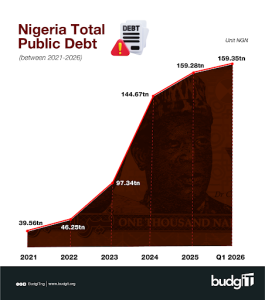
For decades, Nigeria has relied on borrowing to bridge the gap between revenues and expenditures. The deficit figures highlight the scale of the challenge. The 2025 budget projected a deficit of N13.08 trillion¹, while the 2026 budget anticipated deficit financing of N31.46 trillion². This pattern has steadily increased debt stock, raising future servicing costs and gradually shrinking fiscal room for capital spending. The rate of Nigeria’s public debt growth is particularly alarming. Available data published by the Debt Management Office (DMO) shows total public debt rising from about N39.56 trillion in 2021 to about N46.25 trillion in 2022, then jumping to N97.34 trillion in 2023 after elections and renewed borrowing needs. The trajectory continued sharply: public debt rose to approximately N144.67 trillion in 2024 and N159.28 trillion in 2025, peaking around N159.35 trillion by Q1 2026. Over roughly five years, the increment has been extremely steep illustrating the severity of the fiscal problem³.
Domestic borrowing accounts for the majority of the debt profile, which is around N87.40 trillion (54.85%), while external debt is around N71.95 trillion (45.15%)¹. The domestic component is especially challenging because it is often associated with high interest rates. When the government borrows heavily through domestic instruments such as Treasury bills and bonds, it attracts investment away from private lending. In effect, the government becomes the most attractive borrower, crowding out private credit that would otherwise support businesses, manufacturing, commerce, and job creation.
Currency depreciation further worsens the outlook, particularly through its effects on external debt servicing. Even if the dollar equivalent of debt appears to decline, naira depreciation can inflate servicing costs in domestic currency. The claim that the dollar equivalent of public debt fell from about $108.23 billion in 2023 to around $94.23 billion in 2024 while naira-denominated debt surged, illustrates how exchange-rate pressure can intensify budget stress. In practical terms, the government must still pay in naira, and a weaker naira means larger naira allocations for foreign obligations.
As the debt stock grows, debt service costs rise quickly and become harder to manage. Debt service increased from N3.00 trillion in 2021 to N12.36 trillion in 2024. In 2025, actual debt service reached N12.52 trillion by Q3, nearing the approved allocation of N13.43 trillion. For 2026, the proposed debt service is N15.91 trillion². These numbers matter because they show a government spending pattern shifting away from development and toward repayment.
A key warning indicator for Nigeria’s fiscal health is the debt service-to-revenue ratio. For low-income countries, this ratio is commonly referenced as a ceiling of about 20%. Nigeria’s situation, however, has remained far above that benchmark. In 2021, the ratio was approximately 71.77%, with debt service of about N3.00 trillion against total revenue of about N4.18 trillion. It improved to around 48.45% in 2022, but worsened again to roughly 54.97% in 2023 and about 58.91% in 2024. By Q3 2025, it rose further to nearly 67.20%, when debt service was about N12.52 trillion compared with revenue of about N18.63 trillion.
This directly affects capital expenditure, which is critical for long-term growth. Nigeria’s budgeted capex increased from N3.94 trillion in 2021 to N16.77 trillion in the amended 2025 budget. Yet actual capex delivery has been inconsistent. Utilisation was 40.89% in 2021, dropping to approximately 35.33% in 2022. Execution improved noticeably in 2023 (79.99%) and 2024 (84.14%), reportedly influenced by a “three-budget overlap” that created a “bunching” effect in reporting. By Q3 2025, utilisation fell back to around 39.36%, with actual capex of N6.60 trillion. This suggests delays in procurement, administrative constraints, and execution bottlenecks.
When debt service takes up a dominant share of revenue, reflected in the 67.20% by Q3 2025, spending on key sectors such as education, healthcare, and social welfare becomes constrained. Underinvestment in youth and human development today reduces future labour productivity, erodes long-term tax capacity, and creates even greater fiscal pressure later. In effect, servicing debt now can reduce growth tomorrow, making Nigeria’s debt challenges more difficult to manage.
Central to BudgIT’s research intervention is its landmark annual publication, the Federal Government Approved Budget Analysis³, which serves as a vital benchmark for evaluating fiscal sustainability, debt profiles, and national revenue autonomy. Rather than merely diagnosing fiscal distress, the report provides actionable policy roadmaps urging the federal government to diversify revenue streams beyond oil, improve tax collection efficiency, and reduce unproductive operational overheads. Furthermore, BudgIT advocates for aligning future borrowings with high-yield capital investments such as manufacturing, agricultural processing, renewable energy, and local logistics infrastructure to drive long-term economic expansion, enhance institutional credibility, and safeguard subnational fiscal stability.
To reverse this decline, Nigeria needs a coordinated approach that reduces debt stress while strengthening revenue and improving the productivity of public spending. Key actions include strategic debt restructuring, productive borrowing only for high-yield projects, improved revenue mobilisation, strengthening capex execution, scaling PPPs, ensuring macro-fiscal stability to lower borrowing costs, enhancing debt transparency, reducing crowding-out from domestic borrowing, and using short-term relief measures such as freezing non-essential recurrent spending and pursuing concessional support.
Nigeria is at a historic turning point in 2026. The country cannot borrow its way out of a debt trap, nor can it build a modern economy on crumbling infrastructure and a neglected workforce. The way forward requires decisive action: raising revenue sustainably, restructuring obligations responsibly, and redirecting public resources toward productive capital investment and human development so future generations are not condemned to a cycle of poverty and stagnation.