
Empowering Voices Through AI Literacy in Kano

Author

Akinkunmi Oludiran, Ifeoluwa Odetayo


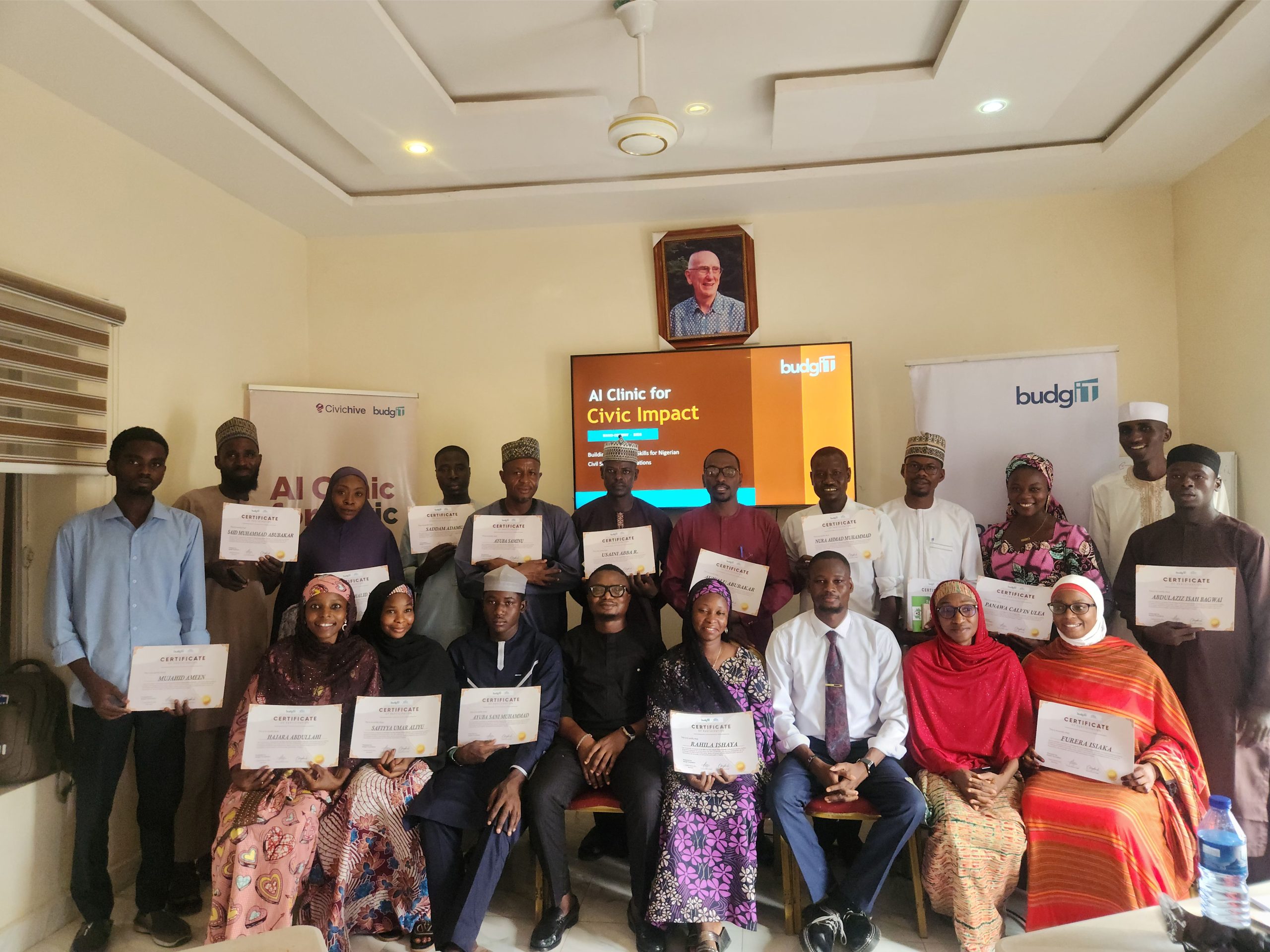
On June 2nd and 3rd, 2026, a transformative energy swept through Kano State. It wasn’t just the heat of the northern sun but the spark of over 20 dedicated hearts—civil society leaders, journalists, curious students, and AI enthusiasts—coming together to upskill through a well-designed programme—AI Clinic for Civic Impact—organised by the BugdIT Foundation. This gathering was not merely a technical workshop; it was a profound moment of human empowerment, where technology was stripped of its intimidating complexity and reshaped into a tool that serves the human spirit.

The Human Need Behind the Digital Tool. 

For many civil society organisations (CSOs) in Nigeria, the daily reality is overwhelming data, unsearchable public records, and constant pressure to prove their impact on the communities they serve. Imagine an advocate for transparent governance spending hours manually sifting through thousands of pages of formatted budget documents just to find one figure. This is where the emotional weight of “time-waste” is felt most—every hour spent on a repetitive manual task is an hour stolen from community engagement, advocacy, and human connection.

The Kano cohort of the AI Clinic recognised this struggle. The facilitators moved beyond the “hype” of artificial intelligence, focusing on “Tool-Fit Thinking”—asking whether a tool truly addresses a bottleneck in a human workflow. The core philosophy of the two-day clinic was clear: AI is most effective when guided by human judgment, ethical standards, and a deep commitment to the public good.

Day One: Building a Foundation of Literacy and Ethics

The clinic began with a deep dive into AI Literacy, defined as the essential ability to understand, evaluate, and use artificial intelligence ethically. Participants didn’t just learn how AI works; they explored the four domains of literacy—functional, ethical, rhetorical, and pedagogical—to build a “mental model” of when and how to deploy these tools.

The most moving part of this session was the focus on Ethical Literacy. In an era where deepfakes and AI-generated misinformation target women with non-consensual imagery or discredit civic actors with synthetic audio, the importance of these tools became personal. Participants didn’t just listen; they engaged in an “Ethics Debate Circle,” grappling with the tension between AI’s potential and risks. They learned that being a “civic voice” in 2026 means becoming a guardian of truth, using verification platforms like Dubawa and video authentication tools like InVID to protect the integrity of their stories.

By the afternoon, the room became a hands-on “AI Marketplace.” Participants rotated through stations, gaining familiarity with tools like NotebookLM for document synthesis and the Bimi Chatbot for public finance queries. The breakthrough moment for many was seeing Bimi in action—a tool that lets a citizen ask a question in plain language about their state’s healthcare allocation and receive an accurate, sourced answer in seconds. This is AI as a servant to humanity: making the “unsearchable” searchable and the “silent” documents speak for the people.

Mastering the Art of Conversation: Instruction Design

One of the most humanising aspects of the clinic was Module 3: Instruction Design for Civic Work. The curriculum treated prompt engineering not as coding but as a new form of communication—learning to “speak” to AI systems effectively. Participants were taught a seven-step development process: Define, Design, Write, Evaluate, Iterate, Document, and Monitor.

In the “Battle of the Prompts” activity, groups competed to rewrite weak, vague instructions into clear, structured requests for policy briefs. They learned to assign the AI a specific role—such as a “policy research analyst”—and provide it with context, tasks, and constraints. The outcome was a visual realisation that AI output quality is directly proportional to the clarity of human input. It reinforced the idea that the human remains the “designer,” providing the intention and the “soul” of the work, while AI provides the efficiency.

Day Two: The Magic of Automation and Meaningful Learning

The second day focused on the “invisible” work of CSOs: operations and evaluation. In the Workflow Automation module, participants saw a startling statistic: task-switching reduces human productivity by 40%. Through a “Time-Waste Audit,” they identified repetitive weekly tasks that drain their energy.

The room transformed into a laboratory as participants built their own “Zaps” and automated pipelines using no-code tools like Zapier and Make. They felt liberated realizing they could automate monthly report generation or field data aggregation without hiring an expensive technical consultant. The goal was “Sustainable Automation”—building systems organisations could maintain internally, ensuring they never depend on technology they do not understand.

The final module, AI for Monitoring, Evaluation, and Learning (MEAL), brought the focus back to beneficiaries. Traditionally, gathering and analysing feedback from the field takes weeks. With AI, participants learned to use Natural Language Processing (NLP) to read and categorise survey responses, identifying success stories and common complaints almost instantly. This allows CSOs to be more responsive and accountable, transforming “data” back into the “human voices” it represents.

Localisation: AI That Speaks the Language of Kano

A recurring theme throughout the two days was Local Relevance. Global AI systems have historically underserved Nigerian communities by focusing primarily on English. The Kano cohort explored the exciting frontier of local tools like YarnGPT, which reads in Hausa, Igbo, and Yoruba, and the NaijaVoices project, which has built large-scale speech datasets through community contributions.

Participants were encouraged not just to use AI, but to help shape it. By contributing voice recordings and transcriptions in Hausa, they ensure that the future of technology in Nigeria accurately reflects the cultural contexts and civic challenges of their own communities. This is the ultimate benefit of AI to humanity: breaking down language barriers and ensuring that no voice is left behind simply because it doesn’t speak the “standard” language of a Silicon Valley server.
Share This Post

Post Author: Akinkunmi Oludiran, Ifeoluwa Odetayo


On June 2nd and 3rd, 2026, a transformative energy swept through Kano State. It wasn’t just the heat of the northern sun but the spark of over 20 dedicated hearts—civil society leaders, journalists, curious students, and AI enthusiasts—coming together to upskill through a well-designed programme—AI Clinic for Civic Impact—organised by the BugdIT Foundation. This gathering was not merely a technical workshop; it was a profound moment of human empowerment, where technology was stripped of its intimidating complexity and reshaped into a tool that serves the human spirit.

The Human Need Behind the Digital Tool. 

For many civil society organisations (CSOs) in Nigeria, the daily reality is overwhelming data, unsearchable public records, and constant pressure to prove their impact on the communities they serve. Imagine an advocate for transparent governance spending hours manually sifting through thousands of pages of formatted budget documents just to find one figure. This is where the emotional weight of “time-waste” is felt most—every hour spent on a repetitive manual task is an hour stolen from community engagement, advocacy, and human connection.

The Kano cohort of the AI Clinic recognised this struggle. The facilitators moved beyond the “hype” of artificial intelligence, focusing on “Tool-Fit Thinking”—asking whether a tool truly addresses a bottleneck in a human workflow. The core philosophy of the two-day clinic was clear: AI is most effective when guided by human judgment, ethical standards, and a deep commitment to the public good.

Day One: Building a Foundation of Literacy and Ethics

The clinic began with a deep dive into AI Literacy, defined as the essential ability to understand, evaluate, and use artificial intelligence ethically. Participants didn’t just learn how AI works; they explored the four domains of literacy—functional, ethical, rhetorical, and pedagogical—to build a “mental model” of when and how to deploy these tools.

The most moving part of this session was the focus on Ethical Literacy. In an era where deepfakes and AI-generated misinformation target women with non-consensual imagery or discredit civic actors with synthetic audio, the importance of these tools became personal. Participants didn’t just listen; they engaged in an “Ethics Debate Circle,” grappling with the tension between AI’s potential and risks. They learned that being a “civic voice” in 2026 means becoming a guardian of truth, using verification platforms like Dubawa and video authentication tools like InVID to protect the integrity of their stories.

By the afternoon, the room became a hands-on “AI Marketplace.” Participants rotated through stations, gaining familiarity with tools like NotebookLM for document synthesis and the Bimi Chatbot for public finance queries. The breakthrough moment for many was seeing Bimi in action—a tool that lets a citizen ask a question in plain language about their state’s healthcare allocation and receive an accurate, sourced answer in seconds. This is AI as a servant to humanity: making the “unsearchable” searchable and the “silent” documents speak for the people.

Mastering the Art of Conversation: Instruction Design

One of the most humanising aspects of the clinic was Module 3: Instruction Design for Civic Work. The curriculum treated prompt engineering not as coding but as a new form of communication—learning to “speak” to AI systems effectively. Participants were taught a seven-step development process: Define, Design, Write, Evaluate, Iterate, Document, and Monitor.

In the “Battle of the Prompts” activity, groups competed to rewrite weak, vague instructions into clear, structured requests for policy briefs. They learned to assign the AI a specific role—such as a “policy research analyst”—and provide it with context, tasks, and constraints. The outcome was a visual realisation that AI output quality is directly proportional to the clarity of human input. It reinforced the idea that the human remains the “designer,” providing the intention and the “soul” of the work, while AI provides the efficiency.

Day Two: The Magic of Automation and Meaningful Learning

The second day focused on the “invisible” work of CSOs: operations and evaluation. In the Workflow Automation module, participants saw a startling statistic: task-switching reduces human productivity by 40%. Through a “Time-Waste Audit,” they identified repetitive weekly tasks that drain their energy.

The room transformed into a laboratory as participants built their own “Zaps” and automated pipelines using no-code tools like Zapier and Make. They felt liberated realizing they could automate monthly report generation or field data aggregation without hiring an expensive technical consultant. The goal was “Sustainable Automation”—building systems organisations could maintain internally, ensuring they never depend on technology they do not understand.

The final module, AI for Monitoring, Evaluation, and Learning (MEAL), brought the focus back to beneficiaries. Traditionally, gathering and analysing feedback from the field takes weeks. With AI, participants learned to use Natural Language Processing (NLP) to read and categorise survey responses, identifying success stories and common complaints almost instantly. This allows CSOs to be more responsive and accountable, transforming “data” back into the “human voices” it represents.

Localisation: AI That Speaks the Language of Kano

A recurring theme throughout the two days was Local Relevance. Global AI systems have historically underserved Nigerian communities by focusing primarily on English. The Kano cohort explored the exciting frontier of local tools like YarnGPT, which reads in Hausa, Igbo, and Yoruba, and the NaijaVoices project, which has built large-scale speech datasets through community contributions.

Participants were encouraged not just to use AI, but to help shape it. By contributing voice recordings and transcriptions in Hausa, they ensure that the future of technology in Nigeria accurately reflects the cultural contexts and civic challenges of their own communities. This is the ultimate benefit of AI to humanity: breaking down language barriers and ensuring that no voice is left behind simply because it doesn’t speak the “standard” language of a Silicon Valley server.

Share This Post

Read More