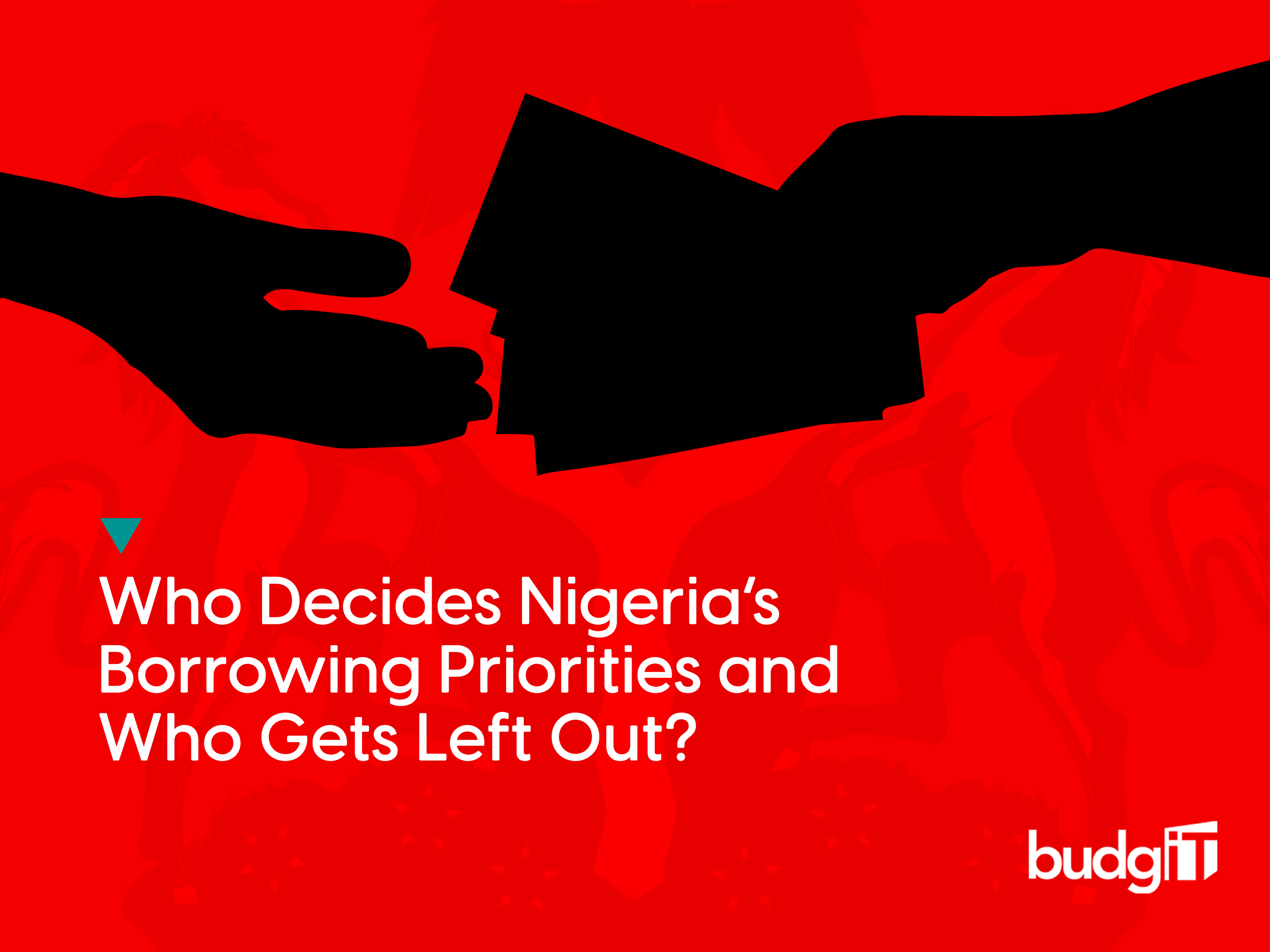

Who Decides Nigeria’s Borrowing Priorities and Who Gets Left Out?

Author

Oludamilola Onemano
$6bn in external loans approved, but what went down? 

On the 31st of March 2026, President Bola Ahmed Tinubu presented a $6bn external borrowing request to the National Assembly as part of the government’s deficit-financing strategy within the N68.3tn 2026 budget framework. The package included $5bn from First Abu Dhabi Bank through a phased Total Return Swap (TRS) financing structure and $1bn from UK Export Finance arranged by Citibank London for the rehabilitation of the Lagos Port Complex and Tin Can Island Port, alongside broader infrastructure support and refinancing of existing obligations. Backed by sections 21(1) and 27(1) of the Debt Management Office (Establishment) Act 2003, a loan of this size needs legislative approval. The request followed Nigeria’s formal borrowing approval pathway. It was read at plenary in both chambers and then referred to the relevant debt committees for review of fiscal implications and sustainability considerations. According to news reports, the approval was granted shortly after, with the Senate concluding its consideration within roughly three and a half hours. Really quick, right? While the process followed institutional requirements, a key stakeholder did not make it to the room. Citizens! 

For many Nigerians, the decision passed quietly. Yet borrowing at this scale shapes the country’s development trajectory for years to come and they should have a say in how those requests are formulated, evaluated and even approved.

Borrowing Has Become a Structural Part of Nigeria’s Budget

Public borrowing is now a routine feature of Nigeria’s fiscal framework.

Nigeria’s fiscal realities mean borrowings will remain necessary. Revenue constraints and infrastructure needs make this unavoidable. The 2026 approved budget of N68.3tn is already bordering on a deficit of above N31tn, which will mostly be financed through loans. Looked at another way, the deficit, which will be plugged by loans and other credit, is slightly under half (approximately 45.4%) of the total budget. Borrowing is now the major support for deficit financing, infrastructure investments and refinancing of existing obligations. As of September 2025, Nigeria’s public debt stood at about N153.3tn, according to the Debt Management Office (DMO). These supports are important, especially for a country that is steadily running huge deficits yearly. But the process through which borrowing priorities are determined deserves more attention than it currently receives. 

Nigeria has a Borrowing Process, but Participation remains limited. Should this matter?

Nigeria’s borrowing framework is institutionally structured. Typically, borrowing proposals are prepared within the Medium-Term Expenditure Framework (MTEF) and transmitted by the President to the National Assembly under the provisions of the Debt Management Office (Establishment) Act 2003. The requests are then referred to the relevant Senate and House committees on local and foreign debts before legislative approval. While debt processes follow the required legal pathway, it raises a broader governance concern: when exactly do citizens engage with borrowing decisions that shape future fiscal space?  It is important to know that institutional approval is not the same as public participation.

As much as it is not a standard practice to hold public hearings and get citizens’ feedback on loan requests, it is a significant component of fiscal transparency and accountability. According to a report by the International Budget Partnership on Addressing Domestic Accountability Challenges in Public Borrowing and Debt Management, it stated, “​​Broadening public participation in debt discussions ensures that borrowing decisions reflect societal priorities and amplify the voices of marginalised groups. CSOs, think tanks, and media play a critical role in translating technical debt issues into relatable narratives and mobilising public support for reforms, such as evaluating the costs and benefits of debt and the trade-offs between borrowing instruments.”

Borrowing decisions determine more than fiscal balances. They influence which sectors receive investment attention and which do not. They shape whether infrastructure improves, whether agricultural productivity improves, whether education systems receive adequate financing and whether social protection programmes improve. Yet most Nigerians encounter borrowing decisions only after they have already been approved. This creates a disconnect between those who influence borrowing priorities and those who ultimately bear the cost of repayment.

One thing that BudgIT has consistently highlighted is the need for clearer public communication around borrowing decisions. Citizens often hear the size of new loans but receive limited information about their sectoral allocation, implementation timelines, sustainability or expected development outcomes. Borrowing decisions should not remain technical conversations within government institutions alone.

This is why borrowing decisions require broader public understanding and engagement.

What is Meaningful Citizen Participation in the borrowing process?

It is already established that citizens rarely engage with borrowing proposals before legislative approval. Public hearings on debt strategy remain limited and simplified explanations of borrowing priorities are not routinely available. These faults do not exclude the subnational governments as well. It is important to understand that expanding participation does not mean delaying borrowing decisions. It means strengthening the quality of those decisions.

Citizens can meaningfully participate by firstly ensuring improved communications, borrowing decisions should be accompanied by clearer communication around what loans finance and how they support long-term economic productivity. Citizens need clear, plain-language information on every loan: its purpose, beneficiaries, timeline, cost breakdown (interest, fees, capital vs. recurrent), affordability outlook (debt-to-GDP and debt-service projections with stress tests), measurable Key Performance Indicators, risk mitigations, alternatives considered and transparent funding flows with regular, accessible reports and open data. The Debt Management Office can partner with the BudgIT Foundation on creating citizen-friendly Information, Education and Communication (IEC) materials to improve sensitisation in a timely manner. Expanding similar transparency to borrowing decisions would strengthen trust and improve development outcomes.

Borrowing works best when citizens understand not only how much the government is borrowing, but why. Knowing why is not enough however, there should be proper public hearings, where citizens (men, women, youths, PWDs, old and young) can question assumptions, influence choices, monitor performance and trigger accountability. Accountability can also be significantly improved if citizens can score the process-implementation and audit, as this will improve tracking and keep leaders on their toes.

A Stronger Voice for Citizens in Borrowing Decisions

We cannot fault the government in its processes, as Nigeria’s borrowing framework is legally structured and institutionally defined. But participation remains limited. The approval of the recent $6bn facility provides an opportunity to reflect on how borrowing priorities are determined and how citizens can engage earlier in the process. Public debt is ultimately a collective national commitment. Decisions about borrowing shape fiscal space, investment priorities and development outcomes for years to come. If Nigerians are expected to carry the long-term implications of borrowing decisions, then Nigerians should also have a stronger voice in shaping them. Are the borrowings necessary? That is a conversation for another day.
Share This Post

Post Author: Oludamilola Onemano
$6bn in external loans approved, but what went down? 

On the 31st of March 2026, President Bola Ahmed Tinubu presented a $6bn external borrowing request to the National Assembly as part of the government’s deficit-financing strategy within the N68.3tn 2026 budget framework. The package included $5bn from First Abu Dhabi Bank through a phased Total Return Swap (TRS) financing structure and $1bn from UK Export Finance arranged by Citibank London for the rehabilitation of the Lagos Port Complex and Tin Can Island Port, alongside broader infrastructure support and refinancing of existing obligations. Backed by sections 21(1) and 27(1) of the Debt Management Office (Establishment) Act 2003, a loan of this size needs legislative approval. The request followed Nigeria’s formal borrowing approval pathway. It was read at plenary in both chambers and then referred to the relevant debt committees for review of fiscal implications and sustainability considerations. According to news reports, the approval was granted shortly after, with the Senate concluding its consideration within roughly three and a half hours. Really quick, right? While the process followed institutional requirements, a key stakeholder did not make it to the room. Citizens! 

For many Nigerians, the decision passed quietly. Yet borrowing at this scale shapes the country’s development trajectory for years to come and they should have a say in how those requests are formulated, evaluated and even approved.

Borrowing Has Become a Structural Part of Nigeria’s Budget

Public borrowing is now a routine feature of Nigeria’s fiscal framework.

Nigeria’s fiscal realities mean borrowings will remain necessary. Revenue constraints and infrastructure needs make this unavoidable. The 2026 approved budget of N68.3tn is already bordering on a deficit of above N31tn, which will mostly be financed through loans. Looked at another way, the deficit, which will be plugged by loans and other credit, is slightly under half (approximately 45.4%) of the total budget. Borrowing is now the major support for deficit financing, infrastructure investments and refinancing of existing obligations. As of September 2025, Nigeria’s public debt stood at about N153.3tn, according to the Debt Management Office (DMO). These supports are important, especially for a country that is steadily running huge deficits yearly. But the process through which borrowing priorities are determined deserves more attention than it currently receives. 

Nigeria has a Borrowing Process, but Participation remains limited. Should this matter?

Nigeria’s borrowing framework is institutionally structured. Typically, borrowing proposals are prepared within the Medium-Term Expenditure Framework (MTEF) and transmitted by the President to the National Assembly under the provisions of the Debt Management Office (Establishment) Act 2003. The requests are then referred to the relevant Senate and House committees on local and foreign debts before legislative approval. While debt processes follow the required legal pathway, it raises a broader governance concern: when exactly do citizens engage with borrowing decisions that shape future fiscal space?  It is important to know that institutional approval is not the same as public participation.

As much as it is not a standard practice to hold public hearings and get citizens’ feedback on loan requests, it is a significant component of fiscal transparency and accountability. According to a report by the International Budget Partnership on Addressing Domestic Accountability Challenges in Public Borrowing and Debt Management, it stated, “​​Broadening public participation in debt discussions ensures that borrowing decisions reflect societal priorities and amplify the voices of marginalised groups. CSOs, think tanks, and media play a critical role in translating technical debt issues into relatable narratives and mobilising public support for reforms, such as evaluating the costs and benefits of debt and the trade-offs between borrowing instruments.”

Borrowing decisions determine more than fiscal balances. They influence which sectors receive investment attention and which do not. They shape whether infrastructure improves, whether agricultural productivity improves, whether education systems receive adequate financing and whether social protection programmes improve. Yet most Nigerians encounter borrowing decisions only after they have already been approved. This creates a disconnect between those who influence borrowing priorities and those who ultimately bear the cost of repayment.

One thing that BudgIT has consistently highlighted is the need for clearer public communication around borrowing decisions. Citizens often hear the size of new loans but receive limited information about their sectoral allocation, implementation timelines, sustainability or expected development outcomes. Borrowing decisions should not remain technical conversations within government institutions alone.

This is why borrowing decisions require broader public understanding and engagement.

What is Meaningful Citizen Participation in the borrowing process?

It is already established that citizens rarely engage with borrowing proposals before legislative approval. Public hearings on debt strategy remain limited and simplified explanations of borrowing priorities are not routinely available. These faults do not exclude the subnational governments as well. It is important to understand that expanding participation does not mean delaying borrowing decisions. It means strengthening the quality of those decisions.

Citizens can meaningfully participate by firstly ensuring improved communications, borrowing decisions should be accompanied by clearer communication around what loans finance and how they support long-term economic productivity. Citizens need clear, plain-language information on every loan: its purpose, beneficiaries, timeline, cost breakdown (interest, fees, capital vs. recurrent), affordability outlook (debt-to-GDP and debt-service projections with stress tests), measurable Key Performance Indicators, risk mitigations, alternatives considered and transparent funding flows with regular, accessible reports and open data. The Debt Management Office can partner with the BudgIT Foundation on creating citizen-friendly Information, Education and Communication (IEC) materials to improve sensitisation in a timely manner. Expanding similar transparency to borrowing decisions would strengthen trust and improve development outcomes.

Borrowing works best when citizens understand not only how much the government is borrowing, but why. Knowing why is not enough however, there should be proper public hearings, where citizens (men, women, youths, PWDs, old and young) can question assumptions, influence choices, monitor performance and trigger accountability. Accountability can also be significantly improved if citizens can score the process-implementation and audit, as this will improve tracking and keep leaders on their toes.

A Stronger Voice for Citizens in Borrowing Decisions

We cannot fault the government in its processes, as Nigeria’s borrowing framework is legally structured and institutionally defined. But participation remains limited. The approval of the recent $6bn facility provides an opportunity to reflect on how borrowing priorities are determined and how citizens can engage earlier in the process. Public debt is ultimately a collective national commitment. Decisions about borrowing shape fiscal space, investment priorities and development outcomes for years to come. If Nigerians are expected to carry the long-term implications of borrowing decisions, then Nigerians should also have a stronger voice in shaping them. Are the borrowings necessary? That is a conversation for another day.
Share This Post

Read More