
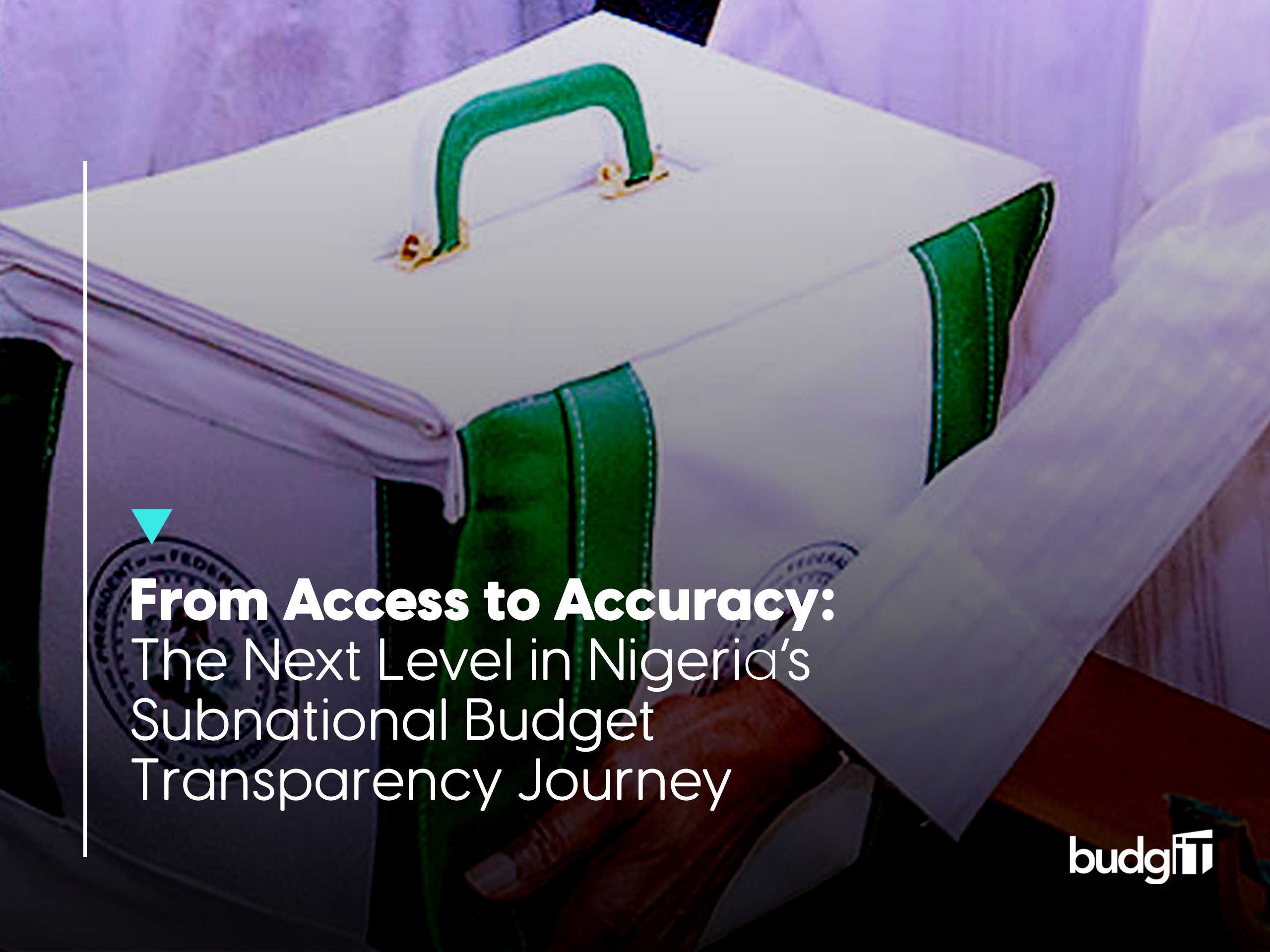

From Access to Accuracy: The Next Level in Nigeria’s Subnational Budget Transparency Journey

Headlines

Author

Vahyala Kwaga

Over the past few years, Nigeria’s subnational governments have made one of the quietest but most consequential gains in fiscal governance – the near-universal publication of Budget Implementation Reports (BIRs). At BudgIT, we monitor and analyse these reports through our Open States platform, and the trend is striking: nearly all 36 states now publish quarterly BIRs that reflect the Administrative, Economic, Functional, Programme, Project, and Geographical classifications of the National Chart of Accounts (NCoA). States aim to release these documents on time (not more than 60 days after the end of the quarter in question) and BudgIT also ensures to measure how that activity is carried out (among other things), through a ranking system called the State Fiscal Transparency League ranking. To return to the key point, these BIRs provide a quarterly snapshot of how much the state has earned and how much it has spent, according to its fiscal plan, or budget. Out of more than thirty reports reviewed recently, only Akwa Ibom (Q2 2025) and Edo (Q4 2024) did not publish comprehensive, fully coded reports.

To reiterate, the present context marks a significant leap from the opacity that once characterised Nigeria’s subnational public finance system. In the very recent past, access to even hard copy versions of the budget was unheard of. Today, citizens, civil society, think tanks, academia and policymakers can track how states allocate funds to education, health, agriculture, or infrastructure, and even see the balance between personnel, overhead, and capital costs. Yet, as transparency deepens, a new question arises: how do we ensure that the quality and consistency of reporting match the progress in access?

Beyond Access: The Challenge of Consistency
Under the NCoA (a framework introduced as part of the IPSAS reform), each budget and expenditure item is expected to be classified across five (sometimes six) key dimensions: Administrative, Economic, Functional, Programme, and Geographic. This structure enables comparisons across states, sectors, and fiscal years. While most states now use the first four classifications, few include the Geographic segment, which specifies where spending occurs within the state. This limits spatial equity analysis, for instance, by distinguishing between funds allocated to rural communities and urban centres.

In addition, timeliness and completeness remain sporadic and non-sequential. Some states delay publication, while others release reports that cover only part of the fourth quarter, such as October to November, instead of the full October to December period. Analysts and citizens then have to wait for the Audited Financial Statements (AFS), typically released around July of the following year, to get the full picture. This lag reduces the usefulness of BIRs for real-time monitoring, policy

See our most recent publication for the second quarter in 2025. The BudgIT Foundation. (2025). State Fiscal Transparency League Index Ranking. Available at: https://budgit.org/wp-content/uploads/2025/09/SFTL-Q22025-2-1.pdf

response, and citizen engagement. These residual gaps may seem minor, but they carry real analytical costs. Inconsistencies in timing or format make it difficult to build reliable cross-state comparisons, track sectoral spending efficiency, or assess compliance with policy benchmarks such as the Abuja Declaration or UNESCO education funding targets. Transparency must evolve from data availability to data standardisation.

Why Standardisation Matters
The difference between “open data” and “usable data” is structure. When states apply budget classifications unevenly, each effectively speaks a different fiscal dialect. Analysts cannot accurately compare how much of Osun’s education spending goes into personnel versus how much of Gombe’s does. Policymakers cannot benchmark efficiency. Citizens cannot ask precise questions about regional imbalances. Donors cannot plan and properly structure their interventions. Uniform reporting is not about bureaucracy: it’s about building a shared language for accountability. This shared language would ensure that transparency and accountability can be assessed, encouraged and supported by anyone, from any state.

At BudgIT, this issue is not abstract. For instance, our flagship publication, the State of States report, relies heavily on data extracted from the Q4 Budget Implementation Reports, especially the Expenditure by Function tables. These datasets form the foundation for our fiscal performance and sustainability rankings. When a state delays its BIR, omits certain classification levels, or stops reporting in November, it directly constrains the depth and comparability of our analysis. In such cases, our team must often defer to the AFS released months later: a necessary but less timely source. The lesson is clear: even as transparency improves, timely, complete, and fully classified BIRs are the foundation of credible fiscal analysis.

Sustaining Progress: The Next Reform Frontier
It is clear that we are not where we used to be. However, it is incumbent on the states not to lose the momentum and push forward. In our view, to sustain this progress, three actions are essential. The first is to institutionalise uniform reporting standards. In pursuance of this, the Federal Ministry of Finance and the Federation Account Allocation Committee (FAAC) should make adherence to all NCoA classifications, including the Geographic segment, mandatory and compulsory across all states. Secondly, states must embed consistency in technology. As such, states should adopt digital reporting templates that automatically apply these classifications and allow for open-data exports (Comma Separated Values, Excel, API). This will make data machine-readable, comparable, and accessible for citizens, researchers, and development partners. Finally, states must aim to build technical and analytical capacity. As a capacity and skill enhancement issue, state Budget and Planning officers need continuous training to understand and apply the NCoA as a management tool, not just a compliance checklist. Whether this is in the form of capacity building or routine training, the skills of Budget officers require constant and consistent training.

Reform incentives also matter. As the State Fiscal Transparency, Accountability and Sustainability (SFTAS) programme demonstrated, performance-based rewards drive transparency compliance. A Budget Data Quality Index could extend that kind of thinking, ranking states not just on whether they publish BIRs, but on how complete, timely, and structured those reports are. The gains and benefits would be visible for all interested stakeholders.

Conclusion
Nigeria’s states have come a long way from the era of opaque budget documents and hidden spending patterns. This is obviously due to the concerted efforts of activists, the media, donor organisations, committed Civil Servants and political appointees. The culmination of actions and pressures has shown that fiscal transparency is achievable and that when states lead, governance improves. The next step is to lock in that progress by ensuring that all states speak the same fiscal language with precision and consistency. This is vital because reforms are fragile things and can be rolled back with surprising ease. We must note that transparency starts with access, but it matures through accuracy and improved reporting. It is critical that the competencies and efforts be redoubled to a new stage of subnational reporting. This will open up new vistas for analysis, conversation and engagement with the government. The time for the new phase is now and in this new phase of Nigeria’s fiscal reform journey, consistency is not just a technical goal, it is the grammar, syntax and style of accountability.
Share This Post

Post Author: Vahyala Kwaga

Over the past few years, Nigeria’s subnational governments have made one of the quietest but most consequential gains in fiscal governance – the near-universal publication of Budget Implementation Reports (BIRs). At BudgIT, we monitor and analyse these reports through our Open States platform, and the trend is striking: nearly all 36 states now publish quarterly BIRs that reflect the Administrative, Economic, Functional, Programme, Project, and Geographical classifications of the National Chart of Accounts (NCoA). States aim to release these documents on time (not more than 60 days after the end of the quarter in question) and BudgIT also ensures to measure how that activity is carried out (among other things), through a ranking system called the State Fiscal Transparency League ranking. To return to the key point, these BIRs provide a quarterly snapshot of how much the state has earned and how much it has spent, according to its fiscal plan, or budget. Out of more than thirty reports reviewed recently, only Akwa Ibom (Q2 2025) and Edo (Q4 2024) did not publish comprehensive, fully coded reports.

To reiterate, the present context marks a significant leap from the opacity that once characterised Nigeria’s subnational public finance system. In the very recent past, access to even hard copy versions of the budget was unheard of. Today, citizens, civil society, think tanks, academia and policymakers can track how states allocate funds to education, health, agriculture, or infrastructure, and even see the balance between personnel, overhead, and capital costs. Yet, as transparency deepens, a new question arises: how do we ensure that the quality and consistency of reporting match the progress in access?

Beyond Access: The Challenge of Consistency
Under the NCoA (a framework introduced as part of the IPSAS reform), each budget and expenditure item is expected to be classified across five (sometimes six) key dimensions: Administrative, Economic, Functional, Programme, and Geographic. This structure enables comparisons across states, sectors, and fiscal years. While most states now use the first four classifications, few include the Geographic segment, which specifies where spending occurs within the state. This limits spatial equity analysis, for instance, by distinguishing between funds allocated to rural communities and urban centres.

In addition, timeliness and completeness remain sporadic and non-sequential. Some states delay publication, while others release reports that cover only part of the fourth quarter, such as October to November, instead of the full October to December period. Analysts and citizens then have to wait for the Audited Financial Statements (AFS), typically released around July of the following year, to get the full picture. This lag reduces the usefulness of BIRs for real-time monitoring, policy

See our most recent publication for the second quarter in 2025. The BudgIT Foundation. (2025). State Fiscal Transparency League Index Ranking. Available at: https://budgit.org/wp-content/uploads/2025/09/SFTL-Q22025-2-1.pdf

response, and citizen engagement. These residual gaps may seem minor, but they carry real analytical costs. Inconsistencies in timing or format make it difficult to build reliable cross-state comparisons, track sectoral spending efficiency, or assess compliance with policy benchmarks such as the Abuja Declaration or UNESCO education funding targets. Transparency must evolve from data availability to data standardisation.

Why Standardisation Matters
The difference between “open data” and “usable data” is structure. When states apply budget classifications unevenly, each effectively speaks a different fiscal dialect. Analysts cannot accurately compare how much of Osun’s education spending goes into personnel versus how much of Gombe’s does. Policymakers cannot benchmark efficiency. Citizens cannot ask precise questions about regional imbalances. Donors cannot plan and properly structure their interventions. Uniform reporting is not about bureaucracy: it’s about building a shared language for accountability. This shared language would ensure that transparency and accountability can be assessed, encouraged and supported by anyone, from any state.

At BudgIT, this issue is not abstract. For instance, our flagship publication, the State of States report, relies heavily on data extracted from the Q4 Budget Implementation Reports, especially the Expenditure by Function tables. These datasets form the foundation for our fiscal performance and sustainability rankings. When a state delays its BIR, omits certain classification levels, or stops reporting in November, it directly constrains the depth and comparability of our analysis. In such cases, our team must often defer to the AFS released months later: a necessary but less timely source. The lesson is clear: even as transparency improves, timely, complete, and fully classified BIRs are the foundation of credible fiscal analysis.

Sustaining Progress: The Next Reform Frontier
It is clear that we are not where we used to be. However, it is incumbent on the states not to lose the momentum and push forward. In our view, to sustain this progress, three actions are essential. The first is to institutionalise uniform reporting standards. In pursuance of this, the Federal Ministry of Finance and the Federation Account Allocation Committee (FAAC) should make adherence to all NCoA classifications, including the Geographic segment, mandatory and compulsory across all states. Secondly, states must embed consistency in technology. As such, states should adopt digital reporting templates that automatically apply these classifications and allow for open-data exports (Comma Separated Values, Excel, API). This will make data machine-readable, comparable, and accessible for citizens, researchers, and development partners. Finally, states must aim to build technical and analytical capacity. As a capacity and skill enhancement issue, state Budget and Planning officers need continuous training to understand and apply the NCoA as a management tool, not just a compliance checklist. Whether this is in the form of capacity building or routine training, the skills of Budget officers require constant and consistent training.

Reform incentives also matter. As the State Fiscal Transparency, Accountability and Sustainability (SFTAS) programme demonstrated, performance-based rewards drive transparency compliance. A Budget Data Quality Index could extend that kind of thinking, ranking states not just on whether they publish BIRs, but on how complete, timely, and structured those reports are. The gains and benefits would be visible for all interested stakeholders.

Conclusion
Nigeria’s states have come a long way from the era of opaque budget documents and hidden spending patterns. This is obviously due to the concerted efforts of activists, the media, donor organisations, committed Civil Servants and political appointees. The culmination of actions and pressures has shown that fiscal transparency is achievable and that when states lead, governance improves. The next step is to lock in that progress by ensuring that all states speak the same fiscal language with precision and consistency. This is vital because reforms are fragile things and can be rolled back with surprising ease. We must note that transparency starts with access, but it matures through accuracy and improved reporting. It is critical that the competencies and efforts be redoubled to a new stage of subnational reporting. This will open up new vistas for analysis, conversation and engagement with the government. The time for the new phase is now and in this new phase of Nigeria’s fiscal reform journey, consistency is not just a technical goal, it is the grammar, syntax and style of accountability.
Share This Post

Read More