
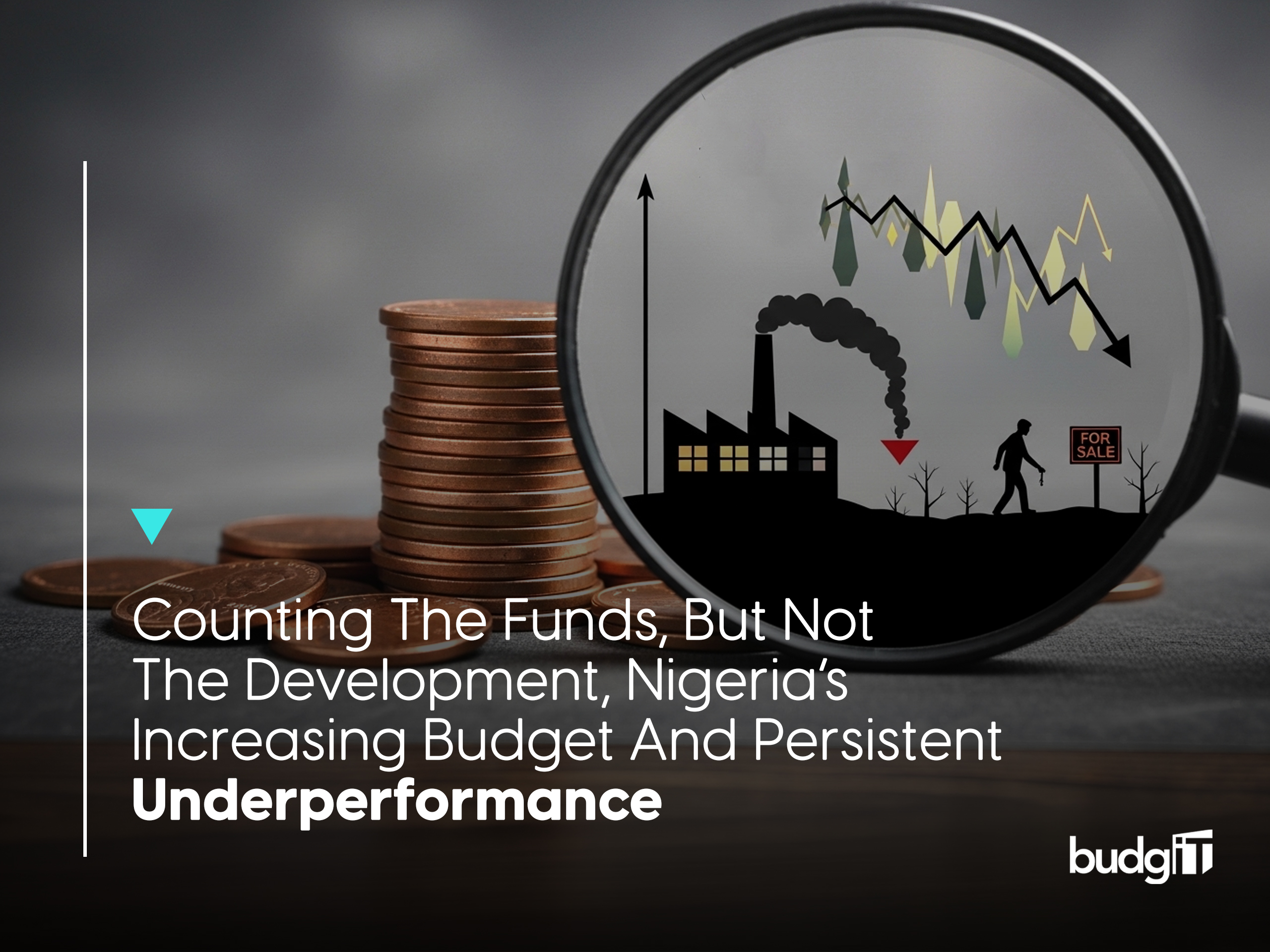

Counting The Funds, But Not The Development, Nigeria’s Increasing Budget And Persistent Underperformance

Author

Ibukunolu James

“On your mandate we shall stand,” resounds as the president presents yet another Federal Government Budget larger than that of the previous year. Trillions of naira are announced with confidence, sectoral allocations are detailed, and assurances are made that the budget will drive growth and enhance living standards. Over the years, Nigeria’s budgets have expanded considerably in nominal terms, fueled by growing expenditure demands, inflation, and rising debt. However, the degree to which approved budgets are executed as intended remains low. One of BudgIT’s core yearly products is the Federal Government Budget Analysis, which examines the big picture of the economy, analyses macroeconomics, debt burden, sectoral analysis, and identifies insertions; not forgetting the theme of the budget as it affects the citizens of Nigeria. Over the years, our analysis has shown that Nigeria’s budgets consistently fall short of expectations. Year after year, poor execution has weakened the country’s public finance system. This persistent gap between what is planned and what is delivered raises a critical question: “What real value do these large budgets bring if they are not effectively implemented?” This is the heart of the budget credibility question.

Looking at Nigeria’s budget growth over recent years, allocations were anchored at N21.83 trillion in 2023, rising to N28.78 trillion in 2024. The real shock came in 2025, when the budget jumped to N54.99 trillion, hailed by citizens as the largest in the nation’s history. Alongside these figures were supplementary budgets of N2.17 trillion and N6.2 trillion in both 2023 and 2024, further expanding government spending plans. Yet, despite the rising numbers, outcomes tell a different story. Expenditure often drifts from development focus, while actual revenues consistently fall short of projections.

Inflow: The Ambitiousness of Revenue Projections

Revenue forecasts are usually built on optimistic assumptions, and when these projections are not met, the weakness of the budget begins to show. In the 2026 budget, the government projects oil at $64.85 per barrel, production at 1.84 million barrels per day, and an exchange rate of N1,400 to the dollar. These figures are above expert forecasts, setting the stage for underperformance. Driven by this optimism, revenue targets are pegged at 14.6% of GDP, well above the more realistic 10.9% estimate. The shortfall in revenue in 2025 quickly translated into poor capital execution: only 26% in early 2025 and 84% for the extended 2024 cycle, with 70% of projects rolled over. Meanwhile, debt servicing consumed N15.91 trillion in the 2026 budget proposal, crowding out funds for infrastructure and social programs. The result was a ballooning deficit of 4.5% of GDP in 2026 and a debt-to-GDP ratio climbing to 39%.

In addition to this, the government cannot spend what it does not earn; capital expenditure is the first casualty. Recurrent costs, salaries, overheads, pensions, and especially debt service take priority. Debt service is treated as a first-line charge, leaving little fiscal space for development. Capital spending, which should drive some key sectors like power, health, and education, is relegated to residual status. When revenues underperform, capital releases are delayed, cut back, abandoned, or cancelled altogether. While the payment of salaries is necessary, true development carries significant weight because it directly improves the quality of life for citizens. Yet, year after year, Nigerians hear of massive budgets, and without strong investment in infrastructure, health, education, and power, those figures remain abstract. Salaries sustain the system, but development transforms it, turning budget numbers into tangible progress that people can feel in their daily lives.

Legislative Alterations; Constituency Projects Serving As Budgetary Chokeholds

Beyond BudgIT’s analysis of the Federal Government’s approved budget, we also examine the insertions made by the National Assembly. During the few weeks that the proposed budget is debated in the legislative chambers, it undergoes a “cut and join” process; the inclusion of alterations that significantly inflate the final figures. These changes often reshape allocations, raising questions about transparency, fiscal discipline, and the true intent of the budget. BudgIT extracted N2.24 trillion worth of insertions from the 2024 budget; this did not stop, as we further extracted NASS insertions to the tune of N6.9 trillion from the 2025 budget. NASS routinely pads budgets with constituency projects (despite their dedicated N100 billion Zonal Intervention Projects), and as we are on the lookout for the 2026 approved budget, N344.8 billion has been allocated for their salaries and perks alone in the proposed budget.

Insertions into Nigeria’s budget trigger massive deficits, squeezing out funds meant for priority capital spending. In this environment, corruption thrives as resources are diverted to unviable and ‘one off’ “empowerment” or “constituency” projects, while critical infrastructure is abandoned and public trust erodes. The distortions weaken capital implementation, and persistent revenue shortfalls translate into real hardship for citizens. The consequences are visible everywhere: stalled infrastructure, rising living costs, and shrinking opportunities that trap millions in poverty. Roads crumble, power supply remains unreliable, and healthcare is inadequate, as 70% of 2025 capital projects roll over unexecuted, leaving communities isolated and vulnerable. Inflation stays at 15%, fueled by deficit-financed spending, with food inflation prices climbing by 10.84% and transport costs surging under a weak naira.
Meanwhile, unemployment hovers near 4.3%, with young people bearing the brunt. Job-creating infrastructure projects lag behind padded constituency allocations, widening the gap between budget promises and lived reality. What emerges is a cycle of fiscal failure, large budgets on paper, but little progress on the ground, deepening poverty, and eroding confidence in governance.

Conclusion

Nigeria’s budgeting problem is far from hidden; it stems from weak discipline, overly optimistic planning, and limited accountability. Unless these root issues are tackled, budgets will continue to look impressive on paper but fail in practice. Fiscal discipline is not a technical aspiration; it is a matter of governance. Accountability must go beyond routine reporting to actual enforcement. Budget performance should carry consequences, whether through sanctions for poor execution or incentives for strong delivery. Without credible enforcement, reforms will remain cosmetic, producing little real change. Legislative amendments also need clearer rules and enforcement to preserve budget coherence and timeliness. Oversight is vital, but it must not undermine fiscal discipline or derail national priorities. Capital spending, which drives infrastructure and long-term growth, must be shielded from cuts. A multi-year capital budgeting framework, backed by realistic cash flow planning, would help reduce project abandonment and improve outcomes. Breaking Nigeria’s cycle of budgetary underperformance requires a fundamental shift. Revenue projections must be conservative and grounded in reality, not wishful thinking. Only then can budgets move from being grand statements to becoming effective tools for development and improved living standards.
Share This Post

Post Author: Ibukunolu James

“On your mandate we shall stand,” resounds as the president presents yet another Federal Government Budget larger than that of the previous year. Trillions of naira are announced with confidence, sectoral allocations are detailed, and assurances are made that the budget will drive growth and enhance living standards. Over the years, Nigeria’s budgets have expanded considerably in nominal terms, fueled by growing expenditure demands, inflation, and rising debt. However, the degree to which approved budgets are executed as intended remains low. One of BudgIT’s core yearly products is the Federal Government Budget Analysis, which examines the big picture of the economy, analyses macroeconomics, debt burden, sectoral analysis, and identifies insertions; not forgetting the theme of the budget as it affects the citizens of Nigeria. Over the years, our analysis has shown that Nigeria’s budgets consistently fall short of expectations. Year after year, poor execution has weakened the country’s public finance system. This persistent gap between what is planned and what is delivered raises a critical question: “What real value do these large budgets bring if they are not effectively implemented?” This is the heart of the budget credibility question.

Looking at Nigeria’s budget growth over recent years, allocations were anchored at N21.83 trillion in 2023, rising to N28.78 trillion in 2024. The real shock came in 2025, when the budget jumped to N54.99 trillion, hailed by citizens as the largest in the nation’s history. Alongside these figures were supplementary budgets of N2.17 trillion and N6.2 trillion in both 2023 and 2024, further expanding government spending plans. Yet, despite the rising numbers, outcomes tell a different story. Expenditure often drifts from development focus, while actual revenues consistently fall short of projections.

Inflow: The Ambitiousness of Revenue Projections

Revenue forecasts are usually built on optimistic assumptions, and when these projections are not met, the weakness of the budget begins to show. In the 2026 budget, the government projects oil at $64.85 per barrel, production at 1.84 million barrels per day, and an exchange rate of N1,400 to the dollar. These figures are above expert forecasts, setting the stage for underperformance. Driven by this optimism, revenue targets are pegged at 14.6% of GDP, well above the more realistic 10.9% estimate. The shortfall in revenue in 2025 quickly translated into poor capital execution: only 26% in early 2025 and 84% for the extended 2024 cycle, with 70% of projects rolled over. Meanwhile, debt servicing consumed N15.91 trillion in the 2026 budget proposal, crowding out funds for infrastructure and social programs. The result was a ballooning deficit of 4.5% of GDP in 2026 and a debt-to-GDP ratio climbing to 39%.

In addition to this, the government cannot spend what it does not earn; capital expenditure is the first casualty. Recurrent costs, salaries, overheads, pensions, and especially debt service take priority. Debt service is treated as a first-line charge, leaving little fiscal space for development. Capital spending, which should drive some key sectors like power, health, and education, is relegated to residual status. When revenues underperform, capital releases are delayed, cut back, abandoned, or cancelled altogether. While the payment of salaries is necessary, true development carries significant weight because it directly improves the quality of life for citizens. Yet, year after year, Nigerians hear of massive budgets, and without strong investment in infrastructure, health, education, and power, those figures remain abstract. Salaries sustain the system, but development transforms it, turning budget numbers into tangible progress that people can feel in their daily lives.

Legislative Alterations; Constituency Projects Serving As Budgetary Chokeholds

Beyond BudgIT’s analysis of the Federal Government’s approved budget, we also examine the insertions made by the National Assembly. During the few weeks that the proposed budget is debated in the legislative chambers, it undergoes a “cut and join” process; the inclusion of alterations that significantly inflate the final figures. These changes often reshape allocations, raising questions about transparency, fiscal discipline, and the true intent of the budget. BudgIT extracted N2.24 trillion worth of insertions from the 2024 budget; this did not stop, as we further extracted NASS insertions to the tune of N6.9 trillion from the 2025 budget. NASS routinely pads budgets with constituency projects (despite their dedicated N100 billion Zonal Intervention Projects), and as we are on the lookout for the 2026 approved budget, N344.8 billion has been allocated for their salaries and perks alone in the proposed budget.

Insertions into Nigeria’s budget trigger massive deficits, squeezing out funds meant for priority capital spending. In this environment, corruption thrives as resources are diverted to unviable and ‘one off’ “empowerment” or “constituency” projects, while critical infrastructure is abandoned and public trust erodes. The distortions weaken capital implementation, and persistent revenue shortfalls translate into real hardship for citizens. The consequences are visible everywhere: stalled infrastructure, rising living costs, and shrinking opportunities that trap millions in poverty. Roads crumble, power supply remains unreliable, and healthcare is inadequate, as 70% of 2025 capital projects roll over unexecuted, leaving communities isolated and vulnerable. Inflation stays at 15%, fueled by deficit-financed spending, with food inflation prices climbing by 10.84% and transport costs surging under a weak naira.
Meanwhile, unemployment hovers near 4.3%, with young people bearing the brunt. Job-creating infrastructure projects lag behind padded constituency allocations, widening the gap between budget promises and lived reality. What emerges is a cycle of fiscal failure, large budgets on paper, but little progress on the ground, deepening poverty, and eroding confidence in governance.

Conclusion

Nigeria’s budgeting problem is far from hidden; it stems from weak discipline, overly optimistic planning, and limited accountability. Unless these root issues are tackled, budgets will continue to look impressive on paper but fail in practice. Fiscal discipline is not a technical aspiration; it is a matter of governance. Accountability must go beyond routine reporting to actual enforcement. Budget performance should carry consequences, whether through sanctions for poor execution or incentives for strong delivery. Without credible enforcement, reforms will remain cosmetic, producing little real change. Legislative amendments also need clearer rules and enforcement to preserve budget coherence and timeliness. Oversight is vital, but it must not undermine fiscal discipline or derail national priorities. Capital spending, which drives infrastructure and long-term growth, must be shielded from cuts. A multi-year capital budgeting framework, backed by realistic cash flow planning, would help reduce project abandonment and improve outcomes. Breaking Nigeria’s cycle of budgetary underperformance requires a fundamental shift. Revenue projections must be conservative and grounded in reality, not wishful thinking. Only then can budgets move from being grand statements to becoming effective tools for development and improved living standards.
Share This Post

Read More