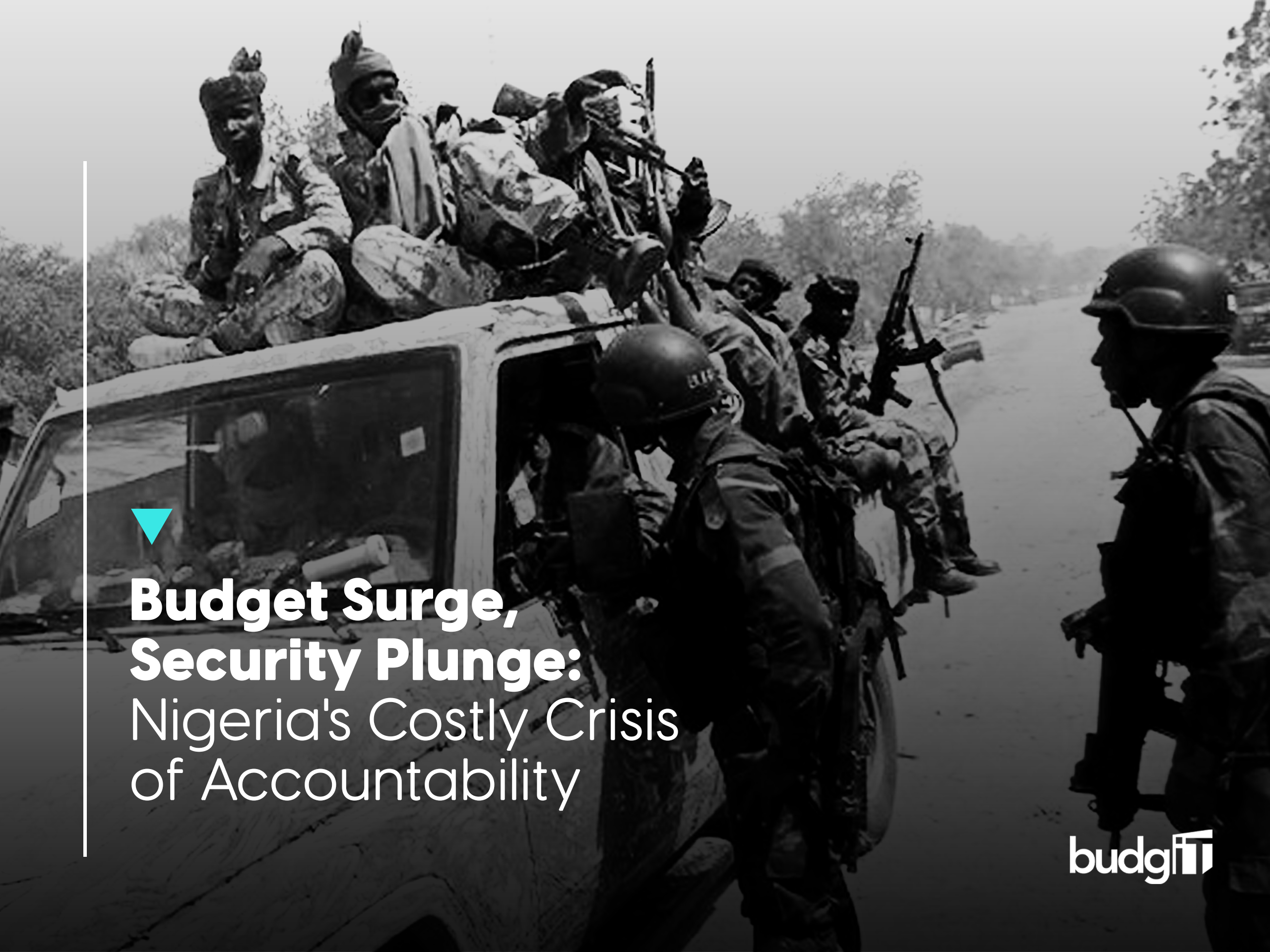

Since Nigeria returned to democratic rule in 1999, security and defence have consistently been prioritised by successive Presidents. Despite substantial investments over the past two decades, the country continues to face widespread insecurity, which has evolved into a complex issue that undermines economic and social stability. From the devastating impact of religious extremists and terrorists in the Northeast to rampant banditry in the Northwest, violent clashes in the Northcentral, and oil-related crime in the South South, along with secessionist unrest in the Southeast and rising crime in the Southwest, Nigeria faces a multitude of security threats that hinder economic growth and pose an existential risk.
The present administration, like its predecessors, pledged to overhaul Nigeria’s national security framework. This administration promised commitments to combat terrorism, kidnapping, and banditry. Key proposals include the formation of specialised anti-terrorist battalions, upgrades to tactical communication and transportation systems, and increasing domestic military production capabilities. This administration also aims to enhance the welfare of military personnel, strengthen community protection efforts, and improve border surveillance. Additionally, there are plans to empower forest guards to monitor violent criminal activities and recruit more police officers. By implementing these measures, the administration intends to restore safety and stability across the nation.
The Nigerian government’s consistent prioritising of the security sector has seen the sector getting the largest share of the national budget in recent years. This trend underscores a clear governmental strategy to combat the nation’s multifaceted security challenges, including Boko Haram/ISWAP insurgency, banditry, farmer-herder conflicts, and separatism through heavy financial investment.
The total allocation to the national security and defence sector, encompassing the Ministry of Defence, Ministry of Police Affairs, Office of the National Security Adviser (ONSA), and others, has shown an alarming upward trajectory:
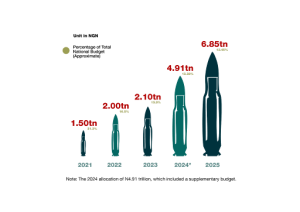
Over the past five years, Nigeria’s security budget has revealed a striking trend marked by significant increases in nominal allocations. From 2021 to 2025, a remarkable N17.36 trillion has been earmarked for security spending. Initially, this budget grew modestly, climbing from N1.5 trillion in 2021 to N2.1 trillion in 2023. However, a dramatic shift occurred in 2024, when the allocation soared to N4.91 trillion, an astonishing 133% increase and ultimately reached a peak of N6.85 trillion in 2025. This surge represented a crucial recalibration of priorities amid an escalating security crisis.
Nigeria’s fiscal year 2025 presents a paradox that demands urgent national scrutiny: a record-breaking investment in national security contrasted with a disturbing surge in violence, displacement, and loss of life. While the government has demonstrated a clear commitment to bolstering security through unprecedented budgetary allocations, the data reveal a systemic failure in accountability, raising serious questions about whether these vast public funds are effectively translating into public safety for Nigerian citizens.
In 2025, the Nigerian government allocated a staggering N6.85 trillion to the Security and Defence sector, marking a 39.5% increase over the previous year’s allocation. This substantial investment signals a determined effort to address the nation’s multifaceted security challenges. A significant portion of this fund, exceeding N987.62 billion, is earmarked for modernisation projects, including a N400.63 billion E-Border Solution designed to enhance border security and stem the flow of illicit activities. Furthermore, substantial appropriations have been allocated for the procurement of advanced military hardware, such as T-129 Attack Helicopters and Unmanned Aerial Systems (UAS), reflecting a strategic shift towards technology-driven military operations and enhanced response capabilities.
Within this expansive security budget of N690.84 billion, representing 10.09% of the total allocation, was directed to the Office of the National Security Adviser (ONSA). This allocation underscores the critical role of ONSA in coordinating intelligence gathering, formulating national security strategies, and leading counter-terrorism efforts. Given its central position in the national security architecture, the effective utilisation of these funds by ONSA is paramount.
The sharp disconnect between massive financial input and poor security output is further complicated by issues of transparency and accountability within the security agencies. A particularly concerning anomaly was reported in the Office of the National Security Adviser (ONSA). As of June 30, 2025, ONSA reported an exceptional capital budget utilisation of 314.59%, having received N228.16 billion against an appropriation of N72.52 billion. While high budget utilisation might typically be viewed as a positive indicator of efficiency, the stark contrast with the worsening security outcomes raises serious questions about the effectiveness and accountability of ONSA’s spending.
When compared to the alarming security data, this financial result indicates that budget utilisation, even at extremely effective rates, does not always result in increased public safety. It draws attention to the structural problems of corruption, poor management, and inadequate monitoring, where money may be effectively spent on unimportant or opaque projects rather than being used to lessen violence and safeguard civilians.
The fact that a high-profile security agency can achieve over 300% budget utilisation while the country experiences a concurrent escalation in deaths from violence challenges the assumption that increased spending is effectively reducing violence in Nigeria. This disconnect underscores the urgent need for greater transparency and oversight in the security sector to ensure that funds are being used effectively and efficiently.
The budget represents a critical opportunity to modernise Nigeria’s security architecture and address the root causes of violence and instability. However, this investment risks becoming a colossal waste if the historical challenges of corruption, mismanagement, and ineffective oversight are not decisively addressed.
Nigeria’s security future hangs in the balance. Without rigorous accountability, even the most substantial financial commitments will only perpetuate a spiralling cycle of violence and impunity, leaving the Nigerian populace to bear the brunt of a costly, yet ineffective, security framework. It is imperative that the government, civil society, and the international community work together to ensure that security spending translates into real and lasting improvements in the safety and well-being of all Nigerians.