
Can We Still Tell What Is True?
Imagine opening your phone months before an election. Your timeline is filled with political messages: campaign videos, news clips, opinion threads, and emotional appeals urging you to support one candidate or reject another. The videos look convincing. The posts sound authoritative. The messages arrive from people you trust.
But what if some of them are completely fake?
In an era where artificial intelligence can generate realistic images, videos, and audio within seconds, the question of truth has become more complicated than ever. How do citizens distinguish between authentic information and carefully engineered manipulation?
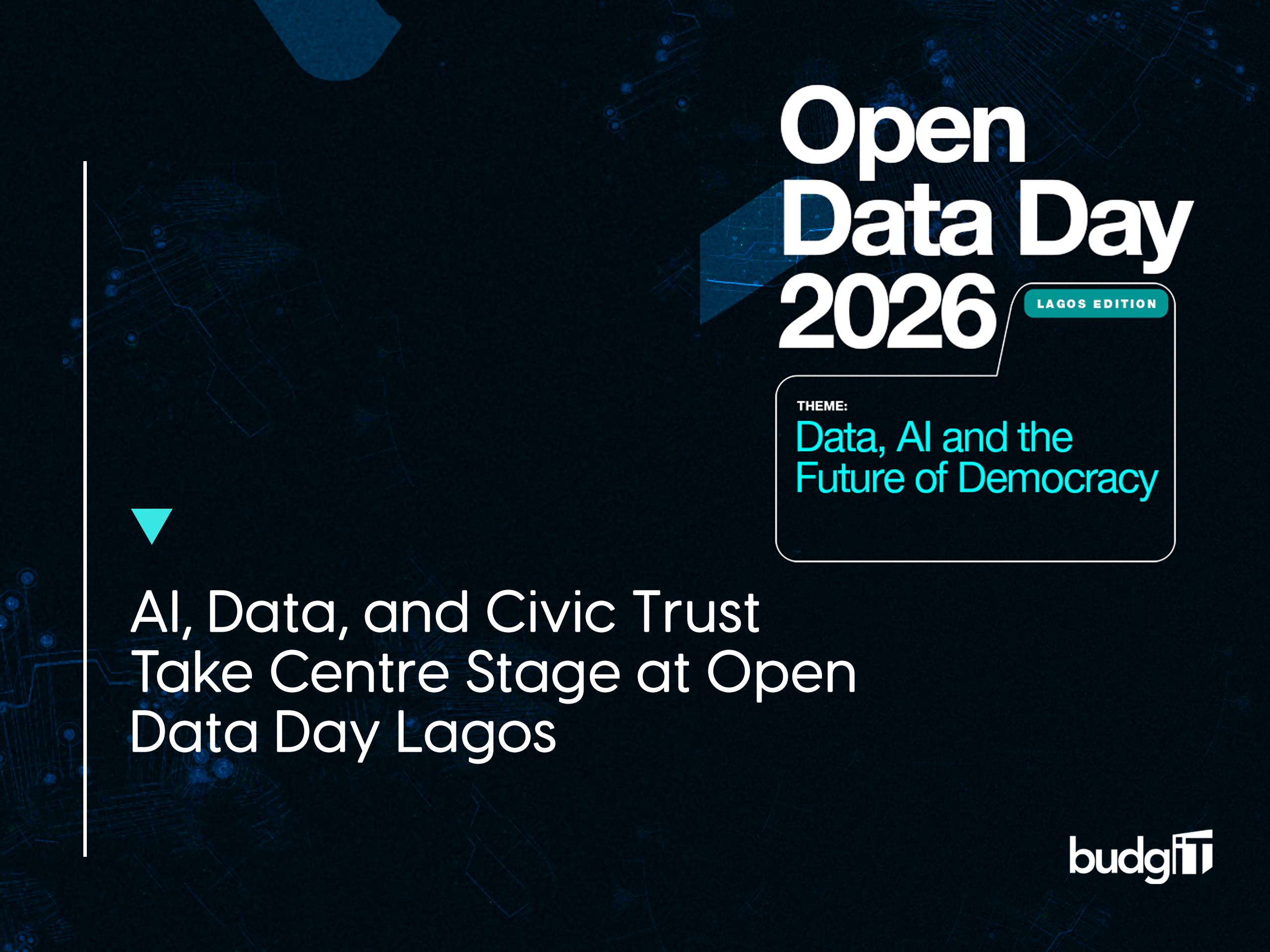
This question sat at the heart of the conversations during Open Data Day Lagos 2026, held on March 11 at Civic Hive in Yaba. Organised by BudgIT Foundation in partnership with Open Knowledge Foundation Nigeria, the event brought together technologists, journalists, policymakers, researchers, and civil society actors to explore one urgent theme: “Data, AI, and the Future of Democracy.”
Open Data Day is celebrated globally as part of the Open Knowledge Foundation’s Open Data Week, which ran from March 7 to March 13, 2026. But the Lagos edition carried a particular sense of urgency. As Nigeria approaches another election cycle and artificial intelligence rapidly reshapes the information ecosystem, questions about truth, trust, and accountability are becoming impossible to ignore.
At the centre of the discussion was a simple but profound question: How can open data help protect democracy in the age of artificial intelligence?
A Warning at the Start
In his opening remarks, Joseph Amenaghawon, Acting Country Director of BudgIT Foundation, set the tone for the conversations that followed. Artificial intelligence, he warned, has already begun to influence how people encounter political information. “We can clearly see what AI can bring in terms of influencing the rest of us on who to vote for or who not to vote for,” he said.
The room fell quiet as he reflected on the implications. The real challenge, he noted, is no longer just about access to information. It is about whether citizens can confidently distinguish between truth and manipulation.
“The coming months will be exciting,” he added, “but they will also leave a lot of people vulnerable to misinformation and deepfakes across Africa.”
His remarks framed the central tension of the event: while artificial intelligence offers powerful new tools, it also creates new vulnerabilities for democratic systems. In this environment, open data may be one of the most important tools citizens have to defend the truth.
Technology and the Risk of Manipulated Politics
The keynote address by ‘Gbenga Sesan, Executive Director of Paradigm Initiative, expanded the conversation beyond Nigeria to the broader global landscape. Artificial intelligence, Sesan explained, carries enormous potential to improve governance and public engagement. Yet the same technologies can also distort political discourse if they are misused.
“Before we talk about using AI in elections,” he said, “we must clearly define what it will actually do.”
His warning was grounded in recent history. Across the world, elections have already seen the rise of troll farms, coordinated disinformation campaigns, and organised digital manipulation designed to shape public opinion. As AI tools become more powerful, these tactics could become even more sophisticated.
“One worrying development is the rise of deepfakes,” Sesan noted. “AI-generated audio or video that appears real but is entirely fabricated.”
During an election cycle, such tools could spread rapidly across digital platforms, influencing voters before corrections have time to catch up. Sesan emphasised that technology itself is not inherently harmful.
“The real question,” he said, “is whether our institutions and societies are prepared to manage the risks.”
Are We Ready for AI in Elections?
If the keynote raised important concerns, the panel discussion that followed explored them in greater depth. Moderated by Misturah Owolabi, the panel brought together voices from AI research, journalism, electoral administration, and civic technology—four sectors that increasingly shape how democratic information flows. One of the most striking perspectives came from Temitope Asama, an AI/ML researcher at Machine Learning Collective Africa.
“I personally believe that Nigeria as a country is not prepared to deploy AI into its electoral processes,” she said. Her concern was not about the technology itself, but about the systems required to use it responsibly. Deploying AI in something as sensitive as elections requires strong governance structures: independent auditing systems, regulatory oversight, transparent standards, and continuous monitoring.
Without these safeguards, AI systems could introduce new risks into already complex electoral environments. Asama also raised an important question about accountability.
“When an AI model fails,” she explained, “holding only the organisation that deployed the model accountable is simply not enough.”
Developers, platforms, regulators, and institutions all share responsibility for ensuring that such technologies are safe and trustworthy. Her remarks highlighted an important truth: adopting AI in elections is not merely a technical decision, it is a governance decision.
A Different Perspective from the Electoral Commission
While some speakers emphasised caution, representatives from the electoral system also pointed to potential opportunities. Representing the Lagos office of the Independent National Electoral Commission (INEC), Tope Adenugba, IT Support Specialist, shared insights into how the institution is already examining the role artificial intelligence could play in improving electoral processes.
According to him, INEC has established a unit tasked with exploring how AI might support election administration.
Potential applications under consideration include:
- Facial recognition technology for voter accreditation.
- AI-assisted systems to detect manipulated digital content.
- Tools to monitor suspicious activities during elections.
Such innovations, he noted, could strengthen electoral integrity by improving verification systems and identifying fraudulent behaviour more quickly. His remarks highlighted an important tension that ran throughout the day’s discussions: artificial intelligence could either strengthen democratic processes or introduce new vulnerabilities, depending on how it is implemented.
The Data Problem Nobody Talks About
Another important dimension of the conversation came from Frank Eleanya, a technology journalist at TechCabal. Artificial intelligence systems, he explained, are only as reliable as the data used to train them. And in Nigeria, the data ecosystem still faces major limitations.
“Nigeria’s data infrastructure remains weak,” Eleanya observed.
Many datasets are incomplete. Others are outdated or biased. In some cases, basic demographic realities are poorly documented or missing entirely. This creates a serious challenge.
When AI systems are trained on incomplete or biased data, those limitations can be reproduced at scale. Entire communities, particularly minority groups, can become invisible within digital systems. Eleanya’s remarks brought the conversation back to one of the day’s central themes: Without reliable, transparent, and inclusive data, the promise of artificial intelligence cannot be realised responsibly.
Why Open Data Matters More Than Ever
While the discussions highlighted many risks, they also pointed toward possible solutions. Open data plays a crucial role in strengthening democratic systems in several ways.
First, it improves transparency. When government data is publicly accessible, journalists and citizens can independently verify claims and challenge misinformation. Second, it strengthens accountability. Civil society organisations can analyse public data to track government spending, monitor policies, and evaluate electoral processes. Third, it enables better technology. Artificial intelligence systems trained on transparent and inclusive datasets are far less likely to reproduce harmful biases.
For organisations like BudgIT Foundation, this mission has long been central to their work.
Through civic technology tools, data platforms, and public education initiatives, BudgIT has consistently worked to translate complex government data into accessible information that citizens can understand and use. Events like Open Data Day provide an opportunity to reflect on how far the open data movement has come and how much work still lies ahead.
A Conversation That Must Continue
One of the most powerful aspects of the event was the diversity of voices in the room.
Journalists sat beside researchers. Civic activists exchanged ideas with policymakers. Students asked questions alongside technology professionals. This kind of multi-stakeholder dialogue was one of the event’s core objectives. Open Data Day Lagos 2026 sought not only to raise awareness but also to:
- Increase public understanding of how AI and data influence elections.
- Demonstrate how open data can mitigate AI-driven electoral risks.
- Strengthen the capacity of journalists, citizens, and civil society organisations to use data for accountability.
- Encourage dialogue around responsible AI governance.
- Generate insights that could inform future policy discussions
In many ways, the gathering felt less like a conference and more like a collective reflection on the future of democracy.
Democracy Needs More Than Technology
As the conversations drew to a close and participants began to leave Civic Hive, one idea lingered in the air: Artificial intelligence is not inherently democratic.
Technology alone cannot protect elections. It cannot guarantee fairness. It cannot replace public trust. Democracy ultimately depends on something deeper: informed citizens, transparent institutions, and accessible information.
As AI becomes increasingly embedded in political systems, the role of open data will only grow more important. The conversations that began in Lagos on March 11 were not the end of that journey. They were only the beginning.
Because in the age of artificial intelligence, the future of democracy may depend on one simple principle: the truth must remain open.